


316/316L grade stainless steel specifications
Both 316 and 316L stainless steels are austenitic stainless steels. Due to the presence of molybdenum, they possess excellent corrosion resistance (especially against chloride corrosion). The main difference between them lies in their carbon content: 316L (low carbon) has a maximum carbon content of 0.03%, offering superior weldability and resistance to sensitization; while standard 316 has a maximum carbon content of 0.08%, providing slightly better strength and high-temperature performance, but requiring more careful welding procedures. Both are marine-grade stainless steels, containing high levels of chromium, nickel, and molybdenum. Their primary difference is the carbon content, which leads to differences in their mechanical properties (e.g., 316 has slightly higher strength) and welding characteristics.
What is 316L stainless steel?
316L stainless steel is a low-carbon, molybdenum-containing austenitic stainless steel known for its excellent corrosion resistance, especially in chloride (such as seawater) and acidic environments. It is therefore considered "marine grade" stainless steel and is widely used in medical, food, chemical, and marine applications. The "L" in 316L stands for low carbon content (maximum 0.03%), which improves weldability and prevents sensitization (carbide precipitation) during welding, giving it superior corrosion resistance compared to standard 316 stainless steel.

316/316L is a type of stainless steel, belonging to the molybdenum-containing austenitic stainless steel family. This grade has higher nickel and molybdenum content, giving it better overall corrosion resistance than 304 stainless steel, especially in terms of resistance to pitting and crevice corrosion in chloride environments. In addition, 316/316L alloy exhibits excellent high-temperature tensile strength, creep strength, and stress rupture strength, as well as excellent formability and weldability. 316L is a low-carbon version of 316 and does not experience sensitization; therefore, it is often used in thick-walled welded components.
316 Related Specifications and Product Names
EURONORM: 1.4401
ASTM/ASME: UNS S316S11
BS 316S31
316 Grade
316 Alloy
316 Type
316L Related Specifications and Product Names
EURONORM: 1.4404
ASTM/ASME: UNS S31603
BS 316S11
316L Grade
316L Alloy
316L Type
Chemical Properties
| C | Mn | Si | P | S | Cr | Mo | Ni | N | |
| 316 (S31600) | 0.08 max | 2.0 max | 0.75 max | 0.045 max | 0.03 max |
min: 16.0 max: 18.0 |
min: 2.0 max: 3.0 |
min: 10.0 max: 14.0 |
0.10 max |
| 316L (S31603) | 0.03 max | 2.0 max | 0.75 max | 0.045 max | 0.03 max |
min: 16.0 max: 18.0 |
min: 2.0 max: 3.0 |
min: 10.0 max: 14.0 |
0.10 max |
Mechanical Properties
| Grade | Tensile Strength ksi (min) | Yield Strength 0.2% ksi (min) | Elongation % | Hardness (Brinell) MAX | Hardness (Rockwell B) MAX |
|
316 (S31600) |
75 | 30 | 40 | 217 | 95 |
|
316L (S31603) |
70 | 25 | 40 | 217 | 95 |
Physical Properties
| Density lbm/in3 | Thermal Conductivity (BTU/h ft. °F) | Electrical Resistivity (in x 10-6) | Modulus of Elasticity (psi x 10-6) | Coefficient of Thermal Expansion (in/in)/°F x 10-6) | Specific Heat (BTU/lb/°F) | Melting Range (°F) |
| 0.29 at 68°F | 100.8 at 68 212°F | 29.1 at 68°F | 29 | 8.9 at 32 – 212° | 0.108 at 68°F | 2500 to 2550 |
| 9.7 at 32 – 1000° | 0.116 at 200°F | |||||
| 11.1 at 32 – 1500° |
Main Differences and Applications
316L (Low Carbon): Due to its low carbon content, it prevents carbide precipitation, thus maintaining corrosion resistance in the heat-affected zone. Therefore, it is the preferred material for welded structures (pipes, tanks).
316 (Standard Type): It has slightly better strength and high-temperature performance than 316L, but welding requires careful handling (solution annealing treatment) to avoid sensitization.
Corrosion Resistance: Compared to 304 stainless steel, both types of stainless steel have stronger corrosion resistance to chlorides and acidic environments, but 316L is more suitable for welded marine applications
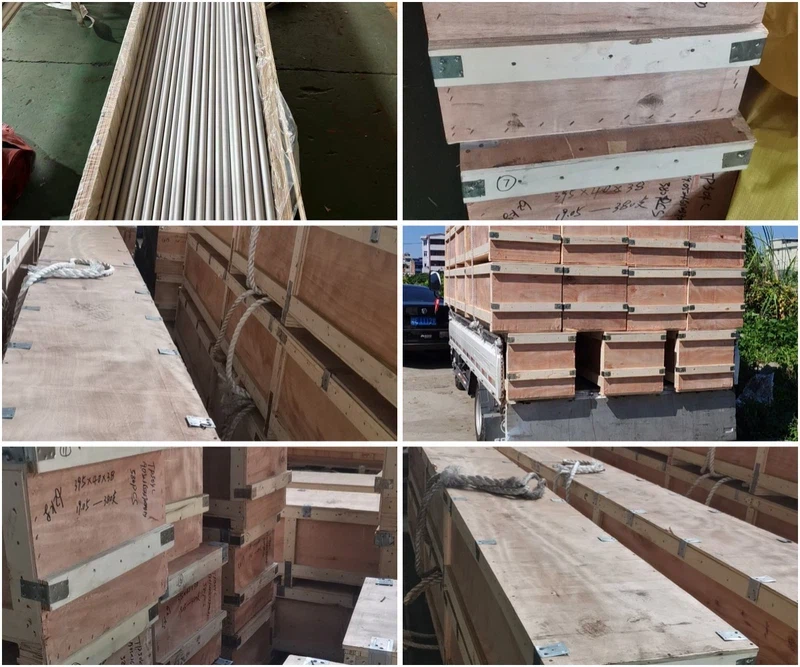
Gnee Steel specializes in the production of a wide range of stainless steel products. Gnee Steel's product packaging includes: Steel Strapping: Pipes with an outer diameter of 3 inches or less are typically strapped together with polypropylene film to prevent rust during ocean shipping, and then secured with steel strapping. Wooden Cases/Crates: Pipes are typically packaged in wooden cases or crates to protect the pipes during transportation, especially those that are longer or have larger diameters. Seaworthy Export Packaging: Suppliers typically use standard seaworthy export packaging methods, which may include a variety of materials and techniques to protect the pipes during transportation. Tarpaulin Packaging: This prevents rain, seawater, and other external factors from penetrating the export crates during transportation. Gnee Steel specializes in the production and sale of alloy materials. Gnee Steel's products are widely used in the aerospace, chemical, power, automotive, and nuclear energy sectors, and we can provide customized alloy material solutions based on customer needs. For alloy material pricing or customized alloy material solutions, please contact us for a quote: ru@gneesteelgroup.com