


Benefits of 316 vs 304 Stainless Steel
Gnee steel
Benefits of 316 vs 304 Stainless Steel
The main advantage of 316 stainless steel over 304 stainless steel lies in its superior corrosion resistance, especially in marine, coastal, chemical, and high-chloride environments, thanks to the added molybdenum. While 304 stainless steel offers excellent overall performance and corrosion protection in general indoor or less demanding applications at a lower cost, for critical applications such as medical implants, acidic food processing, or seawater fittings, the added elements in 316 stainless steel make its higher price worthwhile, as 304 stainless steel would corrode in these applications.

Gnee steel
Which is better for food applications: 304 stainless steel or 316 stainless steel?
For food-grade applications, 304 stainless steel is the standard and more economical choice, suitable for general use with good corrosion resistance and durability. 316 stainless steel is a higher-grade option; due to the addition of molybdenum, it performs better in harsh environments containing salt, strong acids, or chlorides (such as seafood processing or heavy-duty cleaning), offering greater durability and reliability, but at a higher price. Both types of stainless steel meet hygiene standards, are easy to clean, and comply with food safety standards. However, if corrosion is a concern, 316 stainless steel provides better long-term performance, while 304 stainless steel is sufficient for most everyday needs.

What is 304 stainless steel?
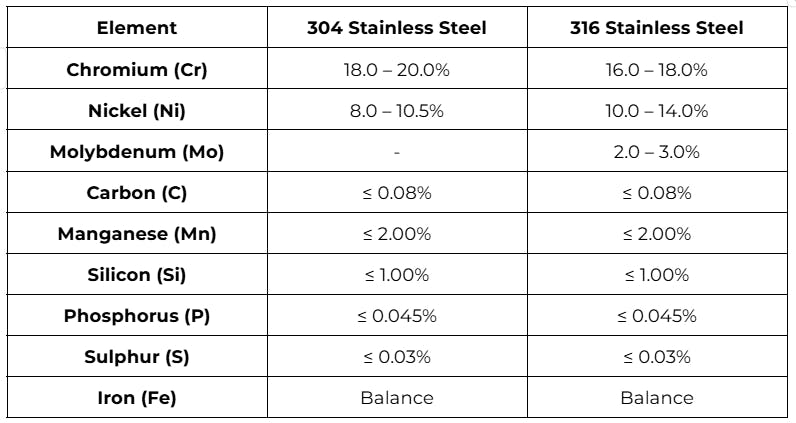
304 stainless steel is the most widely used stainless steel grade in the world. It is known for its excellent corrosion resistance, formability, and strength. As an austenitic stainless steel, it contains a high content of chromium (approximately 18%) and nickel (approximately 8%).
What is 316 stainless steel?
316 stainless steel is similar to 304 stainless steel, but with the addition of an important element: molybdenum. This element enhances its corrosion resistance, especially in environments with chlorides and corrosive chemicals, making it an ideal choice for harsher environments.
Chemical composition of 304 stainless steel and 316 stainless steel
Mechanical Properties of 304 Stainless Steel and 316 Stainless Steel
| Property | 304 Stainless Steel | 316 Stainless Steel |
|---|---|---|
| Tensile Strength (MPa) | ~505 | ~515 |
| Yield Strength (MPa) | ~215 | ~205 |
| Elongation (% in 50mm) | ~70% | ~60% |
| Hardness (Brinell HB) | 201 | 217 |
| Hardness (Rockwell B) | 92 | 95 |
Characteristics and Applications of 304 Stainless Steel
Most of the stainless steel used globally is Grade 304. Its popularity stems from several factors, including:
304 stainless steel is durable, corrosion-resistant, and oxidation-resistant, meaning it can withstand general environmental exposure.
Its melting point ranges from 2550°F to 2650°F, allowing it to withstand very high temperatures.
304 stainless steel is also favored for its high tensile strength of approximately 621 MPa (90 ksi).
The chemical composition of 304 stainless steel is 18% chromium and 8% nickel, making it ideal for many common applications, such as:
Kitchen equipment and appliances
Water pipes
Indoor electrical enclosures
Automotive molds and trim
Wheel covers
Storage tanks
Characteristics and Applications of 316 Stainless Steel
304 and 316 stainless steel share many of the same characteristics. However, it is these additional characteristics that set 316 stainless steel apart.
The addition of molybdenum to the chemical composition of 316 stainless steel increases its resistance to pitting corrosion from harmful acids, alkalis, and chlorides. This extends its lifespan and provides crucial protection for critical components.
Its high chromium and nickel content (typical of austenitic stainless steel alloys) allows it to provide greater strength and corrosion resistance in some of the harshest environments.
The material composition of 316 stainless steel is 16% chromium, 10% nickel, and 2% molybdenum, making it suitable for applications requiring superior corrosion resistance and stringent hygiene and cleanliness requirements. Some of the most common applications include:
Chemical equipment
Pharmaceutical equipment
Outdoor electrical enclosures
Marine parts
Stainless steel baskets
Medical surgical instruments
Stainless steel floats
Advantages of Using 316 Stainless Steel
Comparison of the advantages of 316 stainless steel versus 304 stainless steel (click to enlarge)
When resistance to salt and other chloride corrosion and long-lasting durability are required, the advantages of using 316 stainless steel far outweigh those of 304 stainless steel.
Durability
316 stainless steel is not only strong and durable but also versatile, making it an excellent choice for applications such as custom wire baskets. These wire baskets are often exposed to harsh, high-impact environments, and 316 stainless steel maintains its durability year after year in such conditions.
Corrosion Resistance
The addition of molybdenum to 316 stainless steel gives it superior corrosion resistance compared to 304 or other stainless steel alloys. This allows 316 stainless steel to be used in highly acidic environments where other steels would fail. The corrosion-resistant properties of 316 stainless steel also make it ideal for pharmaceutical and medical applications, as it can withstand the strong disinfectants and high temperatures required for sterilization equipment.
Marine and Shipbuilding Applications
Exposure to salt and chloride environments can severely damage 304 and other stainless steel alloys. Salt corrodes the protective oxide layer of 304 stainless steel, causing it to rust, and 304 stainless steel is also more susceptible to pitting corrosion from salt and chlorides. However, 316 stainless steel possesses all the advantages of 304 stainless steel, plus the added benefit of molybdenum, allowing it to withstand salt and chloride corrosion without damage.

Gnee Steel specializes in the production of a wide range of stainless steel products. Gnee Steel's product packaging includes: Steel Strapping: Pipes with an outer diameter of 3 inches or less are typically strapped together with polypropylene film to prevent rust during ocean shipping, and then secured with steel strapping. Wooden Cases/Crates: Pipes are typically packaged in wooden cases or crates to protect the pipes during transportation, especially those that are longer or have larger diameters. Seaworthy Export Packaging: Suppliers typically use standard seaworthy export packaging methods, which may include a variety of materials and techniques to protect the pipes during transportation. Tarpaulin Packaging: This prevents rain, seawater, and other external factors from penetrating the export crates during transportation. Gnee Steel specializes in the production and sale of alloy materials. Gnee Steel's products are widely used in the aerospace, chemical, power, automotive, and nuclear energy sectors, and we can provide customized alloy material solutions based on customer needs. For alloy material pricing or customized alloy material solutions, please contact us for a quote: ru@gneesteelgroup.com