


316 316L and 316H stainless steel: What are the differences between them?

316 316L and 316H stainless steel: What are the differences between them?
The main difference lies in the carbon content, which determines the primary use of each stainless steel grade: 316L has the lowest carbon content (< 0.03%), making it ideal for welding applications because it exhibits good corrosion resistance after welding; 316H has the highest carbon content (0.04-0.10%), giving it higher strength and creep resistance at high temperatures; while standard 316 has an even higher upper limit for carbon content (0.08%), falling in between the two, but due to its carbon content, it cannot obtain dual certification as both 316L and 316H.
What does 316H mean?
General Properties
316H alloy (UNS S31609) is a high-carbon modified alloy of 316 alloy, specifically developed for high-temperature environments. This alloy exhibits higher strength at high temperatures and is suitable for structural components and pressure vessels operating at temperatures above 932°F (500°C).

316 stainless steel is a molybdenum-containing austenitic chromium-nickel stainless steel. The addition of molybdenum improves its corrosion resistance, enhances its resistance to pitting corrosion from chloride solutions, and increases its high-temperature strength. Except for slightly higher high-temperature strength than 304 stainless steel, its properties are essentially the same as 304 stainless steel. 316 stainless steel exhibits enhanced corrosion resistance, particularly against sulfuric acid, hydrochloric acid, acetic acid, formic acid, tartaric acid, acidic sulfates, and basic chlorides.
316L stainless steel is a low-carbon austenitic chromium-nickel stainless steel with the same corrosion resistance as 316 stainless steel, but with stronger resistance to intergranular corrosion after welding.
316H stainless steel is a high-carbon version of 316 stainless steel, more suitable for high-temperature environments. Balanced 316Ti stainless steel has similar properties. The higher carbon content gives it higher tensile strength and yield strength. The austenitic structure of this material also endows it with excellent toughness, even at low temperatures.
Comparison Table
The table below summarizes the main differences between 316, 316L, and 316H stainless steel.
| Property/Feature | 316 Stainless Steel | 316L Stainless Steel | 316H Stainless Steel |
|---|---|---|---|
| Carbon Content (max) | 0.08% | 0.03% | 0.04–0.10% |
| Corrosion Resistance | Excellent | Excellent (best after welding) | Excellent |
| Weldability | Good (may need post-weld annealing) | Excellent (no annealing needed) | Good (less than 316L) |
| High-Temperature Strength | Good | Moderate | Excellent |
| Typical Uses | Chemical processing, marine parts | Pharmaceutical, food, welded tanks | Boilers, heat exchangers |
| Relevant Standards | ASTM A312, A240, A182 | ASTM A312, A240, A182 | ASTM A312, A240, A182 |
| Mechanical Properties | High strength | Slightly lower strength | Highest at elevated temps |
Chemical Composition %
| Grade | C | Si | P | S | Cr | Mn | Ni | Cu | Mo | Ti | Fe |
| Alloy 316 | 0.08 max | 0.75 max | 0.045 max | 0.030 max | 16.0 - 18.0 | 2.0 max | 10.0 - 14.0 | - | 2.0 - 3.0 | - | Remainder |
| Alloy 316L | 0.03 max | 0.75 max | 0.045 max | 0.030 max | 16.0 - 18.0 | 2.0 max | 10.0 - 14.0 | - | 2.0 - 2.0 | - | Remainder |
| Alloy 316H | 0.04 - 0.10 | 0.75 max | 0.045 max | 0.030 max | 16.0 - 18.0 | 2.0 max | 10.0 - 14.0 | - | 2.0 - 3.0 | - | Remainder |
Physical Properties
| Units | Temperature in °C | |
| Density | 7.99 g/cm³ | Room |
| Specific Heat | 0.12 Kcal/kg.C | 22° |
| Melting Range | 1371 - 1421 °C | - |
| Modulus of Elasticity | 193 KN/mm² | 22° |
| Electrical Resistivity | 74 µΩ.cm | Room |
| Coefficient of Expansion | 16.0 µm/m °C | 20 - 100° |
| Thermal Conductivity | 16.2 W/m -°K | 100° |
| Feature | 316 Stainless Steel | 316L Stainless Steel | 316H Stainless Steel |
|---|---|---|---|
| Carbon Content | ≤ 0.08% | ≤ 0.03% | 0.04 – 0.10% |
| Primary Use | General purpose, balance of properties | Welded structures, environments prone to corrosion after heat exposure | High-temperature applications, pressure vessels |
| Key Advantage | Good corrosion resistance | Excellent weldability and corrosion resistance after welding | High strength and creep resistance at elevated temperatures |
| Weldability | Good, but requires post-weld heat treatment in some cases | Excellent, ideal for welding | Susceptible to sensitization if held in the 450–850°C range |
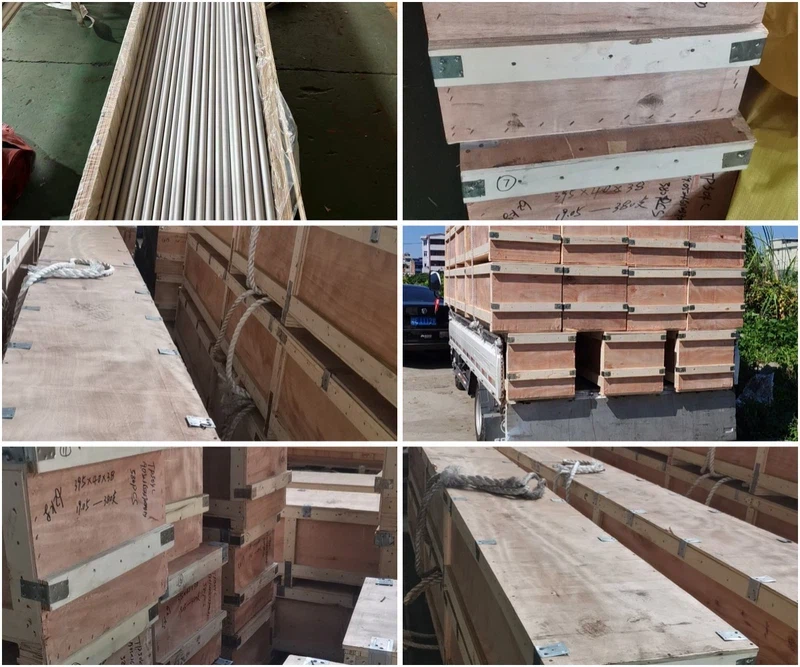
Gnee Steel specializes in the production of a wide range of stainless steel products. Gnee Steel's product packaging includes: Steel Strapping: Pipes with an outer diameter of 3 inches or less are typically strapped together with polypropylene film to prevent rust during ocean shipping, and then secured with steel strapping. Wooden Cases/Crates: Pipes are typically packaged in wooden cases or crates to protect the pipes during transportation, especially those that are longer or have larger diameters. Seaworthy Export Packaging: Suppliers typically use standard seaworthy export packaging methods, which may include a variety of materials and techniques to protect the pipes during transportation. Tarpaulin Packaging: This prevents rain, seawater, and other external factors from penetrating the export crates during transportation. Gnee Steel specializes in the production and sale of alloy materials. Gnee Steel's products are widely used in the aerospace, chemical, power, automotive, and nuclear energy sectors, and we can provide customized alloy material solutions based on customer needs. For alloy material pricing or customized alloy material solutions, please contact us for a quote: ru@gneesteelgroup.com