


The difference between 316 and 316L stainless steel
Gnee Steel
The difference between 316 and 316L stainless steel
The main difference lies in the carbon content: 316 has a maximum carbon content of 0.08%, while 316L (low carbon) has a maximum carbon content of 0.03%. The lower carbon content in 316L prevents sensitization (carbide precipitation) during welding, resulting in stronger corrosion resistance after welding and eliminating the need for post-weld annealing. Therefore, 316L is more suitable for welding projects, while 316, with its slightly higher strength, is more suitable for applications with fewer welds.

Gnee Steel
What are the yield strengths of 316 and 316L stainless steels?
316L stainless steel has a lower carbon content, resulting in slightly higher corrosion resistance, but this is not the primary difference between the two materials. Their mechanical properties also differ slightly due to their different compositions. 316 stainless steel has a yield strength of 30 kSi, while 316L stainless steel has a yield strength of 25 kSi.

Chemical Compatibility Chart Of DIN 1.4436
| Grade | C | Mn | Si | P | S | Cr | Mo | Ni | N | |
| 316 | min. | – | – | – | – | – | 16.0 | 2.0 | 10.0 | – |
| max. | 0.08 | 2.0 | 0.75 | 0.045 | 0.03 | 18.0 | 3.0 | 14.0 | 0.10 | |
Mechanical Properties Database Of UNS S31600
| Grade | Elongation (% in 50mm) min | Strength of Yield 0.2% Proof (MPa) minimum | Strength of Tensile (MPa) minimum | Pipe Hardness | |
| Rockwell B (HR B) maximum | Brinell (HB) maximum | ||||
| 316 | 40 | 205 | 515 | 95 | 217 |
Chemical Compatibility Chart Of UNS S31603
| Grade | C | Mn | Si | P | S | Cr | Mo | Ni | Fe |
| SS 316L | 0.035 max | 2 max | 1.0 max | 0.045 max | 0.030 max | 16.0-18.0 | 2.0-3.0 | 10.0-14.0 | 68.89 min |
Typical Mechanical Property Ranges Of Type 316l
| Melting Point | Density | Tensile Strength | Elongation | (0.2%Offset) Yield Strength |
| (2550 °F)1400 °C | 8.0 | MPa – 515, Psi – 75000 | 35 % | MPa – 205, Psi – 30000 |
| Feature | 316 Stainless Steel | 316L Stainless Steel |
|---|---|---|
| Carbon Content | Maximum 0.08% | Maximum 0.03% |
| Weldability | Good, but susceptible to "weld decay" or sensitization unless annealed after welding | Excellent, due to low carbon content minimizing carbide precipitation |
| Corrosion Resistance | Good, but can be compromised by welding without proper heat treatment | Excellent, especially after welding, due to the reduced risk of sensitization |
| Mechanical Properties | Slightly higher strength and hardness | Slightly lower strength and hardness |
| Best For | Applications with minimal welding where higher strength is required | Applications requiring extensive welding or prolonged exposure to high heat |
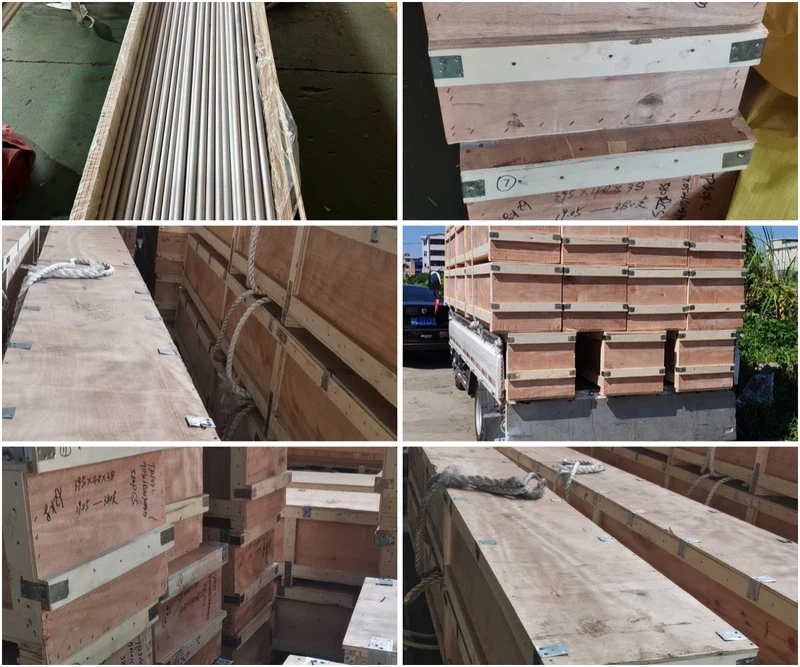
Gnee Steel specializes in the production of a wide range of stainless steel products. Gnee Steel's product packaging includes: Steel Strapping: Pipes with an outer diameter of 3 inches or less are typically strapped together with polypropylene film to prevent rust during ocean shipping, and then secured with steel strapping. Wooden Cases/Crates: Pipes are typically packaged in wooden cases or crates to protect the pipes during transportation, especially those that are longer or have larger diameters. Seaworthy Export Packaging: Suppliers typically use standard seaworthy export packaging methods, which may include a variety of materials and techniques to protect the pipes during transportation. Tarpaulin Packaging: This prevents rain, seawater, and other external factors from penetrating the export crates during transportation. Gnee Steel specializes in the production and sale of alloy materials. Gnee Steel's products are widely used in the aerospace, chemical, power, automotive, and nuclear energy sectors, and we can provide customized alloy material solutions based on customer needs. For alloy material pricing or customized alloy material solutions, please contact us for a quote: ru@gneesteelgroup.com


