


ASTM A269 TP321 stainless steel welded pipe for electric heating
ASTM A269 TP321 stainless steel welded pipe is suitable for electrically heated applications because its titanium stabilization provides excellent resistance to carbide precipitation, making it durable at high temperatures (up to approximately 900°C or 1650°F). This grade offers good scaling resistance and high-temperature strength, but proper welding technique must be ensured, taking into account that the titanium content of TP321 is not recommended for welding consumables, while TP347 is generally preferred for welding 321 base metal.


What is 321 grade stainless steel pipe made of?
321 grade stainless steel pipe is a titanium-stabilized austenitic steel. Titanium stabilization imparts good corrosion resistance to the material. However, the presence of titanium also limits its use as a welding material due to its poor migration properties during arc welding.
SA 269 TP 321 Welded Tubes Mechanical Properties
| Grade | Yield Strength 0.2% Proof (MPa) minimum | Tensile Strength (MPa) minimum | Elongation (% in 50 milimeter) minimum | Hardness | |
| Rockwell B (HR B) maximum | Brinell (HB) maximum | ||||
| 321 | 205 | 515 | 40 | 95 | 217 |
| 321H | 205 | 515 | 40 | 95 | 217 |
ASTM A269 Grade TP321 ERW Tubes Equivalent
| Grade | UNS No | Old British | Euronorm | Swedish SS | Japanese JIS | ||
| BS | En | No | Name | ||||
| 321 | S32100 | 321S31 | 58B, 58C | 1.4541 | X6CrNiTi18-10 | 2337 | SUS 321 |
| 321H | S32109 | 321S51 | – | 1.4878 | X10CrNiTi18-10 | – | SUS 321H |
SA 269 Grade TP321 Tubing Physical Properties
| Grade | Elastic Modulus (GPa) | Density (kg/m3) | Thermal Conductivity (W/m.K) | Mean Coefficient of Thermal Expansion (m/m/0C) | |||
| at 5000C | at 1000C | 0-3150C | 0-1000C | 0-5380C | |||
| 321 | 193 | 8027 | 22.2 | 16.1 | 17.2 | 16.6 | 18.6 |
Key Characteristics and Considerations for Electric Heating
High-Temperature Performance: The titanium in TP321 acts as a stabilizer, preventing the formation of chromium carbides within the sensitization temperature range (approximately 425-850°C). This ensures the material maintains its corrosion resistance and strength in high-temperature applications such as electric heating elements.
Scale Resistance: TP321 can withstand high temperatures without significant scaling, which is critical to maintaining the long-term integrity and functionality of heating elements.
Welding Considerations:
While 321 is an excellent parent material, its titanium content makes it unsuitable for welding.
For welding applications, standard practice is to use a matching or higher-grade welding consumable, such as TP347 (stabilized with niobium), to ensure the weld maintains its high-temperature strength and corrosion resistance.
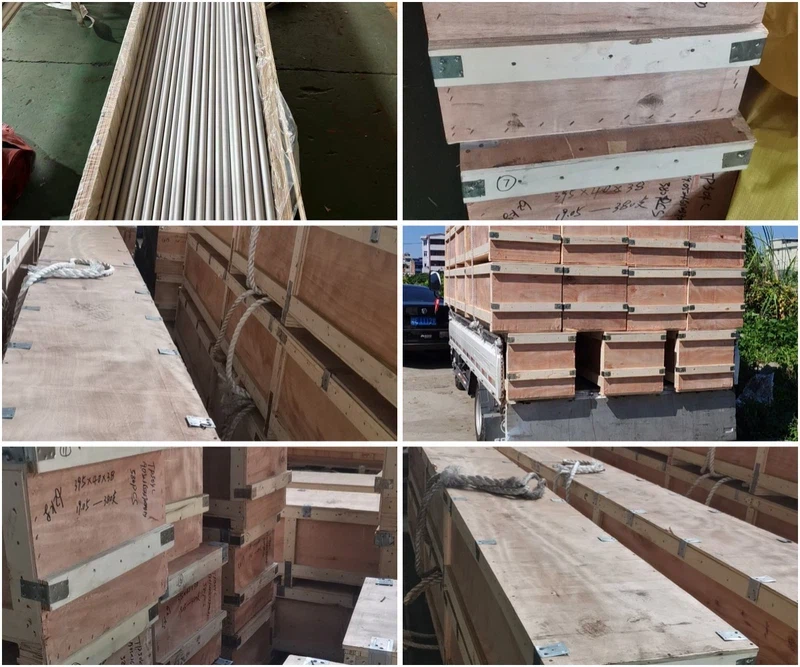
Gnee Steel specializes in the production of a wide range of stainless steel products. Gnee Steel's product packaging includes: Steel Strapping: Pipes with an outer diameter of 3 inches or less are typically strapped together with polypropylene film to prevent rust during ocean shipping, and then secured with steel strapping. Wooden Cases/Crates: Pipes are typically packaged in wooden cases or crates to protect the pipes during transportation, especially those that are longer or have larger diameters. Seaworthy Export Packaging: Suppliers typically use standard seaworthy export packaging methods, which may include a variety of materials and techniques to protect the pipes during transportation. Tarpaulin Packaging: This prevents rain, seawater, and other external factors from penetrating the export crates during transportation. Gnee Steel specializes in the production and sale of alloy materials. Gnee Steel's products are widely used in the aerospace, chemical, power, automotive, and nuclear energy sectors, and we can provide customized alloy material solutions based on customer needs. For alloy material pricing or customized alloy material solutions, please contact us for a quote: ru@gneesteelgroup.com


