


What is the ASTM standard for 304 stainless steel?

What is the ASTM standard for 304 stainless steel?
304 stainless steel does not have a single ASTM standard; instead, different standards cover its applications in various product forms. Common standards include ASTM A240 (for plates, sheets, and strips for pressure vessels/general use), ASTM A276 (bars/profiles), and ASTM A312 (seamless/welded pipes). There are also corresponding ASME standards, such as SA240, SA276, and SA312, which ensure that its chemical composition and mechanical properties meet the requirements for general use, piping, and structural applications.
What are the standards for Type 304 stainless steel?
Type 304 stainless steel is the most common and widely used type of stainless steel. It is sometimes still referred to as 18/8 stainless steel, a name derived from its nominal composition: 18% chromium and 8% nickel. Type 304 stainless steel is an austenitic stainless steel and can be deep-drawn.

Stainless Steel 304 is a general-purpose austenitic stainless steel, characterized by its excellent corrosion resistance, formability, weldability, and heat resistance. It exhibits stable performance in mild atmospheric conditions, freshwater, and various chemical media. It is widely used in kitchenware, home appliance casings, architectural decoration, food industry equipment, and general mechanical components. It is the most commonly used and cost-effective stainless steel grade, but it is not suitable for high-chloride or highly corrosive environments.
Chemical composition of Stainless Steel 304
| Element | Stainless Steel 304 (UNS S30400) |
|---|---|
| Chromium (Cr) | 18.0 – 20.0 % |
| Nickel (Ni) | 8.0 – 10.5 % |
| Iron (Fe) | Balance |
| Carbon (C) | ≤ 0.08 % |
| Manganese (Mn) | ≤ 2.0 % |
| Silicon (Si) | ≤ 1.0 % |
| Phosphorus (P) | ≤ 0.045 % |
| Sulfur (S) | ≤ 0.030 % |
| Nitrogen (N) | ≤ 0.10 % |
Mechanical properties of Stainless Steel 304
| Property | Value |
|---|---|
| Proof Stress | 200 Min MPa |
| Tensile Strength | 500 - 700 MPa |
| Elongation | 45 Min% |
Physical Properties of Stainless Steel 304
| Property | Value |
|---|---|
| Density | 8000.00 Kg/m3 |
| Melting Point | 1450 °C |
| Thermal Expansion | 17.2 x 10⁻⁶ /K |
| Modulus of Elasticity | 193 GPa |
| Thermal Conductivity | 16.2W/m.K |
| Electrical Resistivity | 0.072 x 10⁻⁶ Ω .m |
Common ASTM standards for 304 stainless steel:
ASTM A240: Covers chromium and chromium-nickel stainless steel plates, sheets, and strips for pressure vessels and general applications; a very commonly used standard for flat products.
ASTM A276: Specifies stainless steel bars and shapes.
ASTM A312: Applicable to seamless and welded austenitic stainless steel pipes.
ASTM A269: Covers seamless and welded austenitic stainless steel tubing for general applications.
ASTM A666: Applicable to stainless steel strips in the annealed condition.
When specifying 304 stainless steel, you must also specify its form (sheet, tube, bar, etc.) to determine which ASTM standard applies, as the standard specifies requirements for specific product types.
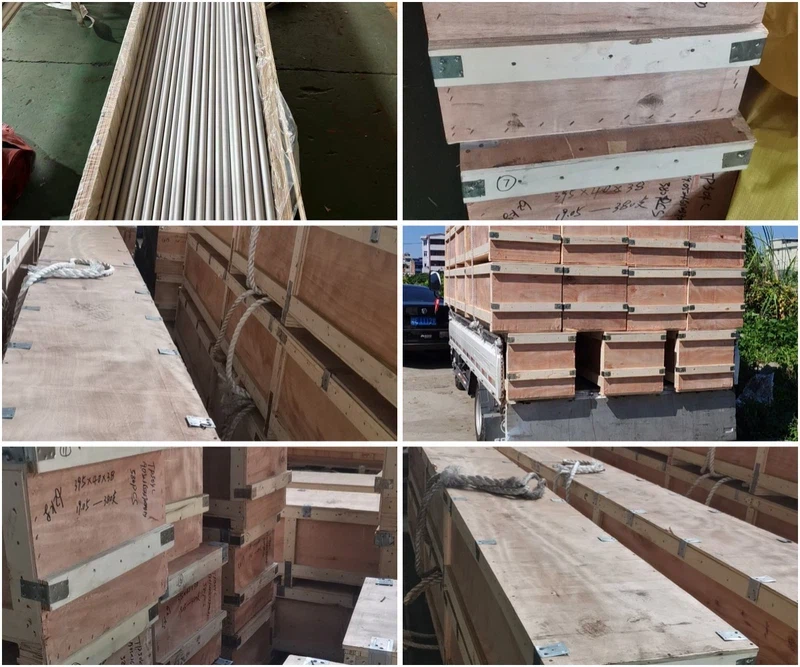
Gnee Steel specializes in the production of a wide range of stainless steel products. Gnee Steel's product packaging includes: Steel Strapping: Pipes with an outer diameter of 3 inches or less are typically strapped together with polypropylene film to prevent rust during ocean shipping, and then secured with steel strapping. Wooden Cases/Crates: Pipes are typically packaged in wooden cases or crates to protect the pipes during transportation, especially those that are longer or have larger diameters. Seaworthy Export Packaging: Suppliers typically use standard seaworthy export packaging methods, which may include a variety of materials and techniques to protect the pipes during transportation. Tarpaulin Packaging: This prevents rain, seawater, and other external factors from penetrating the export crates during transportation. Gnee Steel specializes in the production and sale of alloy materials. Gnee Steel's products are widely used in the aerospace, chemical, power, automotive, and nuclear energy sectors, and we can provide customized alloy material solutions based on customer needs. For alloy material pricing or customized alloy material solutions, please contact us for a quote: ru@gneesteelgroup.com