


What are the differences between 410 stainless steel and 316 stainless steel?
What are the differences between 410 stainless steel and 316 stainless steel?
410 stainless steel is a high-hardness, strongly magnetic martensitic stainless steel with high strength, suitable for general applications, but its corrosion resistance is only average, hence its lower price. 316 stainless steel is a non-magnetic austenitic stainless steel with excellent corrosion resistance (especially excellent resistance to chlorides due to the presence of molybdenum) and good weldability, making it ideal for harsh marine or chemical environments, but it is more expensive and has slightly lower hardness. The main trade-off between the two is cost versus performance; 410 stainless steel offers better value for money when manufacturing high-strength components, while 316 stainless steel provides top-tier protection in harsh environments.
Can a magnet attract 410 stainless steel?
410 stainless steel is magnetic because it is a martensitic stainless steel, meaning it has a body-centered cubic (ferritic) structure and a high iron content, making it attractive to magnets, especially after heat treatment hardening. Unlike non-magnetic austenitic stainless steels (such as 304 or 316), 400 series stainless steels, including 410, have inherent magnetism due to their iron-rich composition and crystal structure.
410 stainless steel is a high-hardness, strongly magnetic martensitic stainless steel with high strength, suitable for general applications, but its corrosion resistance is average, hence its lower price. 316 stainless steel is a non-magnetic austenitic stainless steel with excellent corrosion resistance (especially against chlorides due to its molybdenum content) and good weldability, making it ideal for harsh marine or chemical environments, but it is more expensive and slightly less hard. The main trade-off between the two is cost versus performance; 410 stainless steel offers better value for money when manufacturing high-strength components, while 316 stainless steel provides top-tier protection in harsh environments.
UNS S316000 is an austenitic stainless steel with a molybdenum content of 2-3% and a higher chromium content than 410 stainless steel, typically 16-18%. Therefore, it offers better corrosion resistance than 410 stainless steel in most environments. Furthermore, 316 stainless steel is more heat-resistant than 410 stainless steel and less susceptible to certain chemicals. The disadvantage is that, due to its higher chromium and molybdenum content, 316 stainless steel is significantly more expensive than 410 stainless steel.

Chemical Composition of Stainless Steel 410 vs 316
| Element | 316 Stainless Steel | 410 Stainless Steel | Impact on performance |
| Cr | 16.00 – 18.00 | 11.5 – 13.5 | Provides basic corrosion resistance and forms a surface passivation layer |
| Ni | 10.00 – 14.00 | ≤ 0.75 | Stabilizes the austenite structure, significantly improving ductility and cost |
| Mo | 2.00 – 3.00 | None or trace | Core difference! Greatly enhanced resistance to pitting and crevice corrosion |
| C | ≤ 0.08 | 0.08 – 0.15 | Increases hardness and strength, but reduces weldability and toughness |
Mechanical Properties of Stainless Steel 410 vs 316
| Property | 316 Stainless Steel | 410 Stainless Steel |
|---|---|---|
| Tensile Strength | 520-700 MPa | 480-700 MPa |
| Yield Strength | 205 MPa (min) | 205 MPa (min) |
| Elongation | 40% (min) | 18% (min) |
| Hardness | HRB 90-95 | HRB 80-90 |
| Impact Toughness | Good | Poor |
| Fatigue Strength | High | Low |
| High-Temperature Performance | Suitable for high-temperature environments (up to 870°C) | Suitable for medium to high temperatures (up to 600°C) |
| Corrosion Resistance | Excellent (resistant to acids, saltwater) | Fair (poor resistance to acids) |
Physical Properties of 316 vs 410 Stainless Steel
| Property | Stainless Steel 316 | Stainless Steel 410 |
|---|---|---|
| Density (g/cm³) | ~7.99 | ~7.75 |
| Melting Point (°C) | 1370-1400 | 1480-1530 |
| Thermal Conductivity (W/m·K) | ~16.2 at 100°C | ~24.9 at 100°C |
| Electrical Resistivity (ohm·m) | ~7.4 x 10^-7 at 20°C | ~5.7 x 10^-7 at 20°C |
| Coefficient of Thermal Expansion (µm/m·K) | ~16.5 (20-100°C) | ~10.8 (20-100°C) |
| Specific Heat Capacity (J/kg·K) | ~500 at 20°C | ~460 at 20°C |
| Magnetic Properties | Non-magnetic (Annealed) | Magnetic (All Conditions) |
Application of 316 vs 410 Stainless Steel
Applications of 410 Stainless Steel:
Automotive Industry
Aerospace Industry
Oil and Gas Industry
Tableware and Kitchenware
Power Generation
Applications of 316 Stainless Steel:
Chemical Processing
Medical and Pharmaceutical Industries
Marine Applications
Food and Beverage Processing
Summary of Key Differences
|
Parameter |
304 Stainless Steel |
316 Stainless Steel |
|---|---|---|
|
Corrosion Resistance |
Moderate resistance to corrosion |
High resistance to corrosion |
|
Primary Alloy Element |
Chromium-nickel alloy |
Chromium-nickel-molybdenum alloy |
|
Resistance to Chemicals |
Limited chemical resistance |
Superior chemical resistance |
|
Ideal Environment |
Dry or indoor environments |
Marine, chemical, or food processing industries |
|
Cost |
Lower cost than 316 |
Higher cost due to added molybdenum |
|
Strength |
Comparable good tensile strength |
Similar tensile strength |
|
Magnetic Properties |
Non-magnetic in annealed condition |
Non-magnetic in annealed condition |
|
Applications |
Structural items, appliances, automotive parts |
Marine parts, medical devices, chemical equipment |
|
Heat Resistance |
Good oxidation resistance at high temperatures |
Excellent for high heat and corrosive conditions |
|
Weldability |
Excellent weldability |
Excellent weldability |
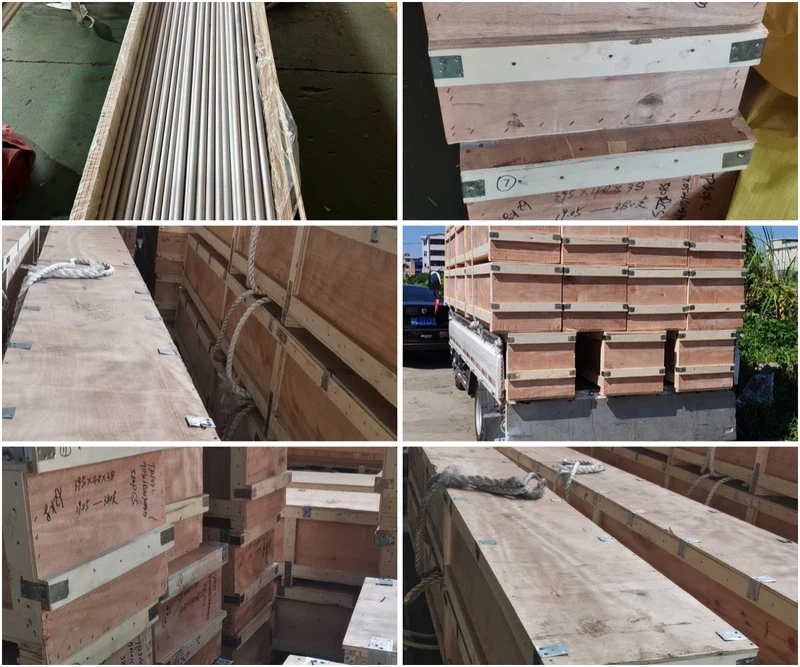
Gnee Steel specializes in the production of a wide range of stainless steel products. Gnee Steel's product packaging includes: Steel Strapping: Pipes with an outer diameter of 3 inches or less are typically strapped together with polypropylene film to prevent rust during ocean shipping, and then secured with steel strapping. Wooden Cases/Crates: Pipes are typically packaged in wooden cases or crates to protect the pipes during transportation, especially those that are longer or have larger diameters. Seaworthy Export Packaging: Suppliers typically use standard seaworthy export packaging methods, which may include a variety of materials and techniques to protect the pipes during transportation. Tarpaulin Packaging: This prevents rain, seawater, and other external factors from penetrating the export crates during transportation. Gnee Steel specializes in the production and sale of alloy materials. Gnee Steel's products are widely used in the aerospace, chemical, power, automotive, and nuclear energy sectors, and we can provide customized alloy material solutions based on customer needs. For alloy material pricing or customized alloy material solutions, please contact us for a quote: ru@gneesteelgroup.com