


Stainless Steel 316L vs. 904L: How to Choose the Right Material

Stainless Steel 316L vs. 904L: How to Choose the Right Material
In environments such as marine, medical, or food processing, where standard and cost-effective corrosion resistance is required, choose 316L stainless steel, which offers an excellent balance between performance and cost. However, for extreme conditions involving strong acids, high chloride concentrations, or petrochemical products, 904L stainless steel should be selected. 904L has a superior alloy composition (higher nickel, molybdenum, and copper content), making its higher cost worthwhile, especially in applications requiring critical reliability, although it is also more difficult to process. 904L excels in areas where 316L is insufficient, particularly in resistance to pitting corrosion and stress corrosion cracking.
Is 316L stainless steel of good quality?
316L stainless steel is a high-quality alloy widely used in the medical and Swiss watchmaking industries. It is commonly used in the manufacture of surgical instruments, implants, and medical devices. Its low allergenicity and corrosion resistance make it a safe and reliable material.

What is 316L steel?
316L stainless steel is an austenitic alloy, often referred to as "marine grade stainless steel" because it can be used in almost 90% of marine applications-including filtration. In addition to metals like iron and nickel, 316L contains 16-18% chromium and 2-3% molybdenum. These elements are crucial because they improve the alloy's corrosion resistance; chromium reacts with oxygen in seawater to form a protective chromium oxide layer, while molybdenum enhances the metal's resistance to pitting corrosion. Furthermore, 316L has a lower carbon content (hence the "L" in the name), which gives it even greater corrosion resistance.
What is 904L steel?
Like 316L, 904L stainless steel is also a low-carbon austenitic stainless steel. However, its chemical composition contains higher levels of chromium (19-23%) and molybdenum (4-5%), making this alloy even more corrosion-resistant than 316L. Some may be familiar with 904L stainless steel as it is a metal commonly used in the manufacture of Rolex watches, which speaks to its high quality and durability. These advantages make it an ideal material for Rolex watches and give it significant advantages in seawater applications.

Chemical Composition of Stainless Steel 316L vs 904L
|
Element |
AISI 316L Stainless Steel (%) |
AISI 904L Stainless Steel (%) |
|
Fe |
Balance | Balance |
|
Cr |
16.0 – 18.0 | 19.0 – 23.0 |
|
Ni |
10.0 – 14.0 | 23.0 – 28.0 |
|
Mo |
2.0 – 3.0 | 4.0 – 5.0 |
|
Cu |
– | 1.0 – 2.0 |
|
C |
≤0.03 | ≤0.02 |
|
Mn |
≤2.00 | ≤2.00 |
|
Si |
≤1.00 | ≤1.00 |
|
P |
≤0.045 | ≤0.045 |
|
S |
≤0.03 | ≤0.035 |
|
N |
≤0.10 | ≤0.10 |
Comparison of Corrosion Resistance between 904L and 316L Stainless Steel
316L Stainless Steel: While 316L stainless steel exhibits strong corrosion resistance to chlorides and seawater, its performance may be inferior to 904L stainless steel in highly corrosive environments such as sulfuric or phosphoric acid.
904L Stainless Steel: Compared to 316L stainless steel, 904L stainless steel offers superior corrosion resistance, especially in highly corrosive chemical environments. Therefore, 904L stainless steel is the preferred choice for applications involving highly corrosive materials such as sulfuric acid.
Physical Properties of Stainless Steel 316L and 904L
|
316L Stainless Steel |
904L Stainless Steel |
|
|
Density |
7.99 g/cm3 | 8.00 g/cm3 |
|
Melting point |
1371-1400°C(2500-2552°F) | 1350-1400°C(2462-2552°F) |
|
Magnetic |
Non-magnetic in the annealed state | Non-magnetic |
|
Thermal Conductivity |
16.0 W/m·K(100℃) | 12.6 W/m·K(100℃) |
|
Thermal Expansion Coefficient |
16.0 μm/m·K (0-100 degrees Celsius) | 15.0 μm/m·K (0-100 degrees Celsius) |
|
Resistivity |
0.074×10^-6Ω·m | 0.085×10^-6Ω·m |
|
Specific Heat |
500 J/kg·K | 450 J/kg·K |
Equivalent Grades of Stainless Steel 316L and 904L
| Standard / Country | 316L (Standard Austenitic) Equivalent Grades | 904L (Super Austenitic) Equivalent Grades |
|---|---|---|
| UNS (Unified Numbering System) | S31603 | N08904 |
| ASTM / ASME | ASTM A240 / A312 / A213 Type 316L | ASTM A240 / A312 / A213 Type 904L |
| EN / DIN (Europe / Germany) | EN 1.4404 / X2CrNiMo17-12-2 | EN 1.4539 / X1NiCrMoCu25-20-5 |
| JIS (Japan) | SUS 316L | SUS 904L |
| GB (China) | 022Cr17Ni12Mo2 | 00Cr20Ni25Mo4.5Cu |
| BS (United Kingdom) | 316S11 / 316S12 | 904S13 |
| ISO | 316L | 904L |
| AFNOR (France) | Z2CND17-12 | Z2NCDU25-20-5 |
| GOST (Russia) | 03Х17Н14М3 | 03Х22Н26М2Д2Т |
Comparison of Strength and Durability between 904L and 316L Stainless Steel
316L Stainless Steel: 316L stainless steel is strong and durable, but under extreme conditions, its robustness is generally not as good as 904L stainless steel.
904L Stainless Steel: Due to its high nickel and molybdenum content, 904L stainless steel is more durable and wear-resistant, especially in highly corrosive or high-temperature environments.
How to Choose
For mild/moderate corrosive environments (limited budget): Choose 316L stainless steel. If 316L performance is sufficient for your needs and you have a limited budget, it's a sensible choice for standard applications.
For harsh/extreme corrosive environments (high performance required): Choose 904L stainless steel. 904L provides the necessary protection when dealing with corrosive chemicals (such as strong acids) or in critical offshore/chemical applications where failure is unacceptable.
Key deciding factors: The corrosiveness of your environment and your budget.
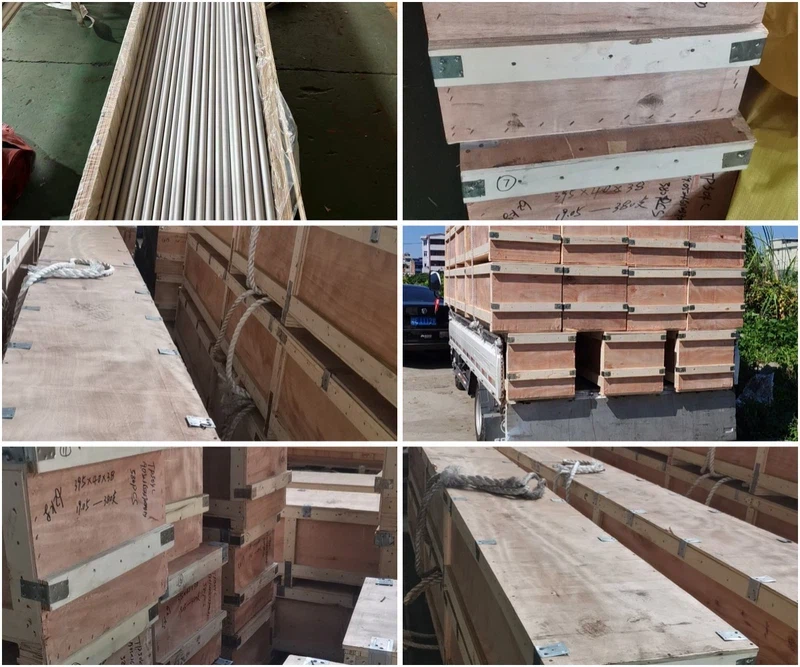
Gnee Steel specializes in the production of a wide range of stainless steel products. Gnee Steel's product packaging includes: Steel Strapping: Pipes with an outer diameter of 3 inches or less are typically strapped together with polypropylene film to prevent rust during ocean shipping, and then secured with steel strapping. Wooden Cases/Crates: Pipes are typically packaged in wooden cases or crates to protect the pipes during transportation, especially those that are longer or have larger diameters. Seaworthy Export Packaging: Suppliers typically use standard seaworthy export packaging methods, which may include a variety of materials and techniques to protect the pipes during transportation. Tarpaulin Packaging: This prevents rain, seawater, and other external factors from penetrating the export crates during transportation. Gnee Steel specializes in the production and sale of alloy materials. Gnee Steel's products are widely used in the aerospace, chemical, power, automotive, and nuclear energy sectors, and we can provide customized alloy material solutions based on customer needs. For alloy material pricing or customized alloy material solutions, please contact us for a quote: ru@gneesteelgroup.com