


Food-grade stainless steel 304 and 316 – A complete introductory guide

Food-grade stainless steel 304 and 316 – A complete introductory guide
Both 304 and 316 stainless steel are considered "food grade" stainless steels, safe for direct contact with food, but they differ significantly in their chemical composition and properties. The main difference lies in the fact that 316 stainless steel contains molybdenum, giving it superior corrosion resistance in chloride and highly acidic environments compared to 304 stainless steel.
tire change & repair
Vivamus tortor risus,pharetra ut venenatis ac,rutrum eget anten fusce convallis nibh felis,eget hendrerit diam rhoncus rana miss dictum lacus eleifend nisl efficitur venenatis.
Aliquam eros justo,posuere loborti viverra laoreet matti ullamcper posuere viverra .Aliquam s justo,posuere so lobortis non,viverra laoreet posuere loborti Aliquam eros justo,posuere loborti viverra laoreet matti ullamcorper posuere viverra .Aliquam s justo,posuere so lobortis non,viverra laoreet posuere loborti

In food contact applications, 304 and 316 stainless steel are the two most widely used grades globally. From industrial equipment such as dairy tanks and beverage piping to household cookware, these two grades dominate due to their corrosion resistance, ease of cleaning, and durability. But which is better? And which applications are they suitable for?
Gnee Steel, a global stainless steel supplier, provides an analysis from a supplier's perspective, covering production, processing, and end-user performance.
Comparison of chemical compositions of 304 and 316 stainless steel
| Element | 304 Stainless Steel | 316 Stainless Steel |
|---|---|---|
| Chromium (Cr) | 18–20% | 16–18% |
| Nickel (Ni) | 8–10.5% | 10–14% |
| Molybdenum (Mo) | – | 2–3% |
| Carbon (C) | ≤ 0.08% | ≤ 0.08% |
| Iron (Fe) | Balance | Balance |
Corrosion Resistance of 304 and 316 Stainless Steel in Food Environments
304 Stainless Steel: Exhibits excellent oxidation resistance and resistance to various organic/acidic foods (milk, wine, fruit juice). However, prolonged contact with salt solutions, soy sauce, or high-chloride cleaning agents can lead to pitting corrosion.
316 Stainless Steel: Performs better in high-chloride environments (pickled foods, seafood processing, pickling solutions). Molybdenum forms a more stable passivation layer, effectively preventing pitting and crevice corrosion.
Mechanical and processing properties of 304 and 316 stainless steel

304: Good formability, weldability, and polishability; commonly used for deep-drawn parts such as sinks, frying pans, and storage tanks.
316: Similar mechanical properties to 304, but slightly higher high-temperature strength; due to molybdenum segregation, extra care is required during welding.
Overview of 304 and 316 stainless steel applications
| Sector | Typical Use for 304 | Typical Use for 316 |
| Dairy & Beverage | Tanks, pipes, fermentation vessels | Salted butter, cheese brining tanks |
| Household Kitchenware | Sinks, pots, pans, cutlery | Premium cookware, saltwater-contact utensils |
| Industrial Food Processing | General conveyors, bins, packaging | Seafood processing, soy sauce, vinegar plants |
| Pharma & Medical (cross-over) | General equipment | Sterile equipment exposed to saline & aggressive cleaners |
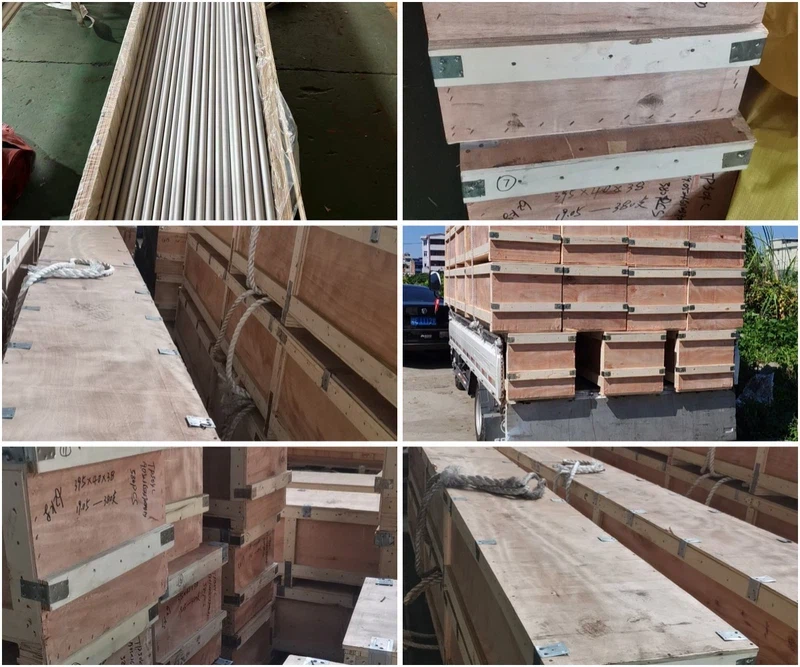
Gnee Steel specializes in the production of a wide range of stainless steel products. Gnee Steel's product packaging includes: Steel Strapping: Pipes with an outer diameter of 3 inches or less are typically strapped together with polypropylene film to prevent rust during ocean shipping, and then secured with steel strapping. Wooden Cases/Crates: Pipes are typically packaged in wooden cases or crates to protect the pipes during transportation, especially those that are longer or have larger diameters. Seaworthy Export Packaging: Suppliers typically use standard seaworthy export packaging methods, which may include a variety of materials and techniques to protect the pipes during transportation. Tarpaulin Packaging: This prevents rain, seawater, and other external factors from penetrating the export crates during transportation. Gnee Steel specializes in the production and sale of alloy materials. Gnee Steel's products are widely used in the aerospace, chemical, power, automotive, and nuclear energy sectors, and we can provide customized alloy material solutions based on customer needs. For alloy material pricing or customized alloy material solutions, please contact us for a quote: ru@gneesteelgroup.com