


904L vs 304L Stainless Steel – What's the Difference

904L vs 304L Stainless Steel – What's the Difference
Both 904L and 304L stainless steels are austenitic stainless steels, but 904L, due to its higher nickel, molybdenum, and copper content, possesses superior corrosion resistance, making it ideal for highly corrosive chemical environments and seawater applications. 304L (a general-purpose standard stainless steel) has a lower nickel content and no copper, making it more cost-effective under milder conditions such as food processing, but it has poorer resistance to chloride corrosion. The main difference between the two lies in their composition (904L contains more nickel, molybdenum, and copper, and has a lower carbon content), which gives 904L higher strength and excellent resistance to pitting and crevice corrosion, while 304L is known for its cost-effectiveness and good formability.
What does the "L" in 304L stainless steel stand for?
The letter L after the grade number, such as 304L, indicates that the carbon content is limited to below 0.03% (the normal maximum carbon content is 0.08%, and some grades can have a maximum carbon content of up to 0.15%).

What is 904L stainless steel?
904L stainless steel is a low-carbon, non-stabilized austenitic stainless steel. Compared to other steels on the market, this steel exhibits excellent formability, weldability, and toughness. Due to its low carbon content and high nickel content, it also possesses strong resistance to crevice corrosion and stress corrosion cracking. 904L stainless steel is widely used in chemical equipment, food processing equipment, medical devices, chemical storage tanks, heat exchangers, pressure vessels, valves, pumps, and nuclear reactors.
What is 304L stainless steel?
304L stainless steel is an austenitic stainless steel with iron as the main alloying element, containing 18-20% chromium and 8-10% nickel. Compared to other steels on the market, this steel exhibits excellent formability and weldability. Its high oxidation resistance makes it an ideal choice for applications where oxidation may be a problem, such as marine applications or chemical processing areas where chlorine or sulfur compounds may be present in the environment. Furthermore, it has excellent corrosion resistance to chloride solutions, making it ideal for food processing equipment or medical devices that frequently come into contact with saltwater or brine solutions.
Differences between 904L and 304L stainless steel:
904L is more expensive than 304L.
904L has better corrosion resistance than 304L.
904L has better resistance to pitting and crevice corrosion than 304L.
904L has better weldability than 304L.
904L is less susceptible to stress corrosion cracking than 304L.
Chemical Composition
| Grade | Chromium | Nickel | Carbon | Manganese | Phosphorus | Sulfer | Silicon | Nitrogen |
| 304L | 18.0-20.0 | 8.0 .-12.0 | 0.030 | 2.00 | 0.045 | 0.030 | 0.75 | 0.10 |
| Grade | Chromium | Nickel | Molybdenum | Silicon | Manganese | Phosphorus | Copper | Sulfur |
| 904L | 19.00-23.00 | 23.00-28.00 | 4.0-5.0 | 1.00 | 2.00 max | 0.045 max | 1.0-2.0 | 0.03 max |
Mechanical Properties
Grade | Tensile Strength (MPa) min | Yield Strength 0.2% Proof (MPa) min | Elongation (% in 50mm) min | Hardness | |
Rockwell B (HR B) | Brinell (HB) | ||||
904L | 490 | 220 | 36 | 70-90 typical | 150 |
| 304L | 485 | 170 | 40 | 92 | 201 |
Main Differences Between 304L and 904L Stainless Steel
Corrosion Resistance:
304L: Suitable for general atmospheric environments/food applications; susceptible to corrosion from chlorides and strong acids.
904L: Offers excellent corrosion resistance to corrosive media such as sulfuric acid, phosphoric acid, and high-chloride/seawater environments, preventing pitting and stress corrosion cracking.
Applications:
304L: Kitchenware, food processing, general construction.
904L: Chemical processing, heat exchangers, pharmaceutical equipment, seawater systems, high-chloride environments.
Cost and Machinability:
304L: Cost-effective and easy to machine.
904L: Higher cost due to higher alloy content; its high ductility means greater cutting forces and tool wear, but it has good formability.
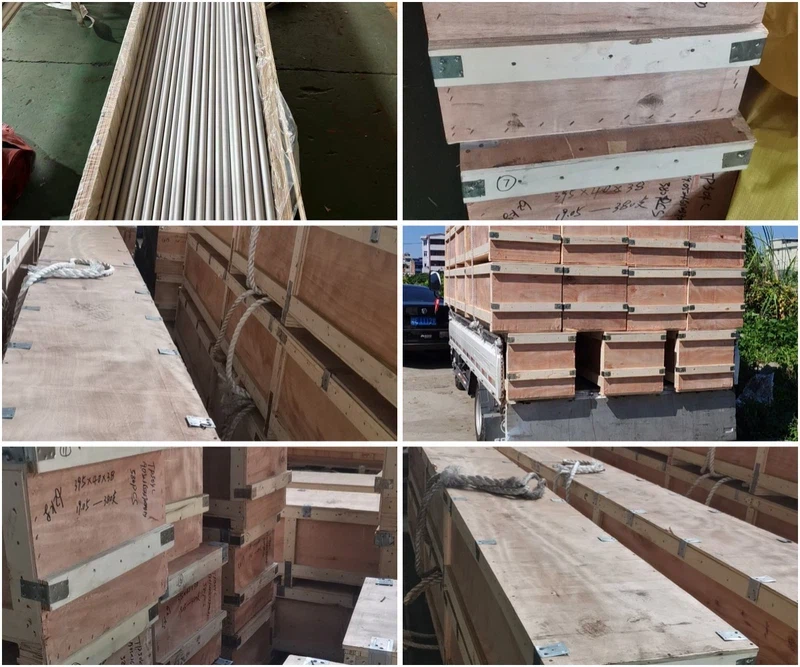
Gnee Steel specializes in the production of a wide range of stainless steel products. Gnee Steel's product packaging includes: Steel Strapping: Pipes with an outer diameter of 3 inches or less are typically strapped together with polypropylene film to prevent rust during ocean shipping, and then secured with steel strapping. Wooden Cases/Crates: Pipes are typically packaged in wooden cases or crates to protect the pipes during transportation, especially those that are longer or have larger diameters. Seaworthy Export Packaging: Suppliers typically use standard seaworthy export packaging methods, which may include a variety of materials and techniques to protect the pipes during transportation. Tarpaulin Packaging: This prevents rain, seawater, and other external factors from penetrating the export crates during transportation. Gnee Steel specializes in the production and sale of alloy materials. Gnee Steel's products are widely used in the aerospace, chemical, power, automotive, and nuclear energy sectors, and we can provide customized alloy material solutions based on customer needs. For alloy material pricing or customized alloy material solutions, please contact us for a quote: ru@gneesteelgroup.com