


What is the manufacturing industry of Inconel 601 pipes?

What is the manufacturing industry of Inconel 601 pipes?
Inconel 601 tubing is a heat- and corrosion-resistant alloy. With nickel-chromium-iron as its primary alloying element, it is ideally suited for use in the chemical and power industries. Its excellent crack resistance and scale resistance allow it to withstand extreme temperatures, making it one of the most popular woodworking materials available today.
What is Inconel 601 material?
Inconel Nickel-Chromium-Iron Alloy 601 (UNS N06601/W.Nr. 2.4851) is a general-purpose engineering material suitable for applications requiring heat and corrosion resistance. A notable characteristic of Inconel Alloy 601 is its excellent resistance to high-temperature oxidation.

Inconel 601 Pipe Specifications
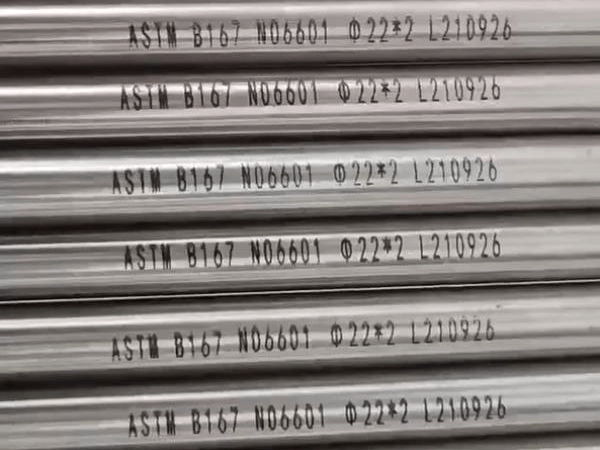
| Standard | ASTM B167 B163 B751 B775 B829 |
|---|---|
| Tube Type | Seamless Tube, welded pipe |
| Alloy | UNS N06601, Inconel 601 |
| Manufacturing | Cold Worked, Hot Worked |
| Outside Diameter | 6 – 1016 Mm |
| Thickness | 0.8 – 50 Mm |
| Pipe Schedule | SCH5, SCH10, SCH10S, SCH20, SCH30, SCH40, SCH40S, STD, SCH80, XS, SCH60, SCH80, SCH120, SCH140, SCH160 |
| Finish | Polished, AP (Annealed & Pickled), BA (Bright & Annealed) |
| Pipe ends | Plain End, Beveled End, Treaded Pipe, Screwed ends |
Chemical Composition of Inconel 601 Tubes
| Element | Nickel (Ni) | Chromium (Cr) | Iron (Fe) | Carbon (C) | Manganese (Mn) | Silicon (Si) | Sulfur (S) | Copper (Cu) |
|---|---|---|---|---|---|---|---|---|
| % Composition | 58.0–63.0 | 21.0–25.0 | Balance | 0.10 max | 1.00 max | 0.50 max | 0.015 max | 1.00 max |
Raw Material Selection
The production journey of Inconel 601 tubing begins with the careful selection of raw materials. Inconel 601 alloy tubing is a nickel-chromium-iron alloy with a significant amount of aluminum. Nickel imparts excellent corrosion resistance, while chromium enhances its oxidation resistance at high temperatures. Aluminum further improves the alloy's ability to form a protective oxide layer on its surface.
We source high-quality raw materials from trusted suppliers. These materials are then analyzed in our state-of-the-art laboratories to ensure they meet the stringent chemical composition requirements for Inconel 601 round tubing. Chemical analysis includes testing the percentages of nickel (at least 58%), chromium (21-25%), iron, aluminum (1.0-1.7%), and other trace elements. Any deviation from the specified composition will affect the final performance of the tubing, making this step crucial.
Smelting and Casting
Once the raw materials have been approved, they are melted in an electric arc furnace or a vacuum induction melting furnace (VIM). Electric arc furnaces are typically used for large-scale production, using an electric arc to heat the raw materials to their melting point. Vacuum induction melting furnaces are used for more precise control of alloy composition and reduction of impurities.
During the melting process, temperature is strictly monitored to ensure all components are completely melted. After melting, the molten alloy is refined to remove residual impurities such as sulfur, phosphorus, and non-metallic inclusions. This refining process helps improve the ductility and corrosion resistance of the final product.
The refined molten alloy is cast into ingots. The casting process requires precise control of temperature and cooling rate to avoid defects such as cracks, porosity, and segregation. The ingots are typically cooled slowly in a controlled environment to ensure uniform solidification and a fine-grained structure.
Forging and Rolling
After casting, the steel ingot is heated to a specific temperature and then forged. Forging is the process of shaping the steel ingot into a more workable form using compressive force. This process helps break up large grains in the ingot and improves the mechanical properties of the alloy. Forging also helps seal any internal voids or cracks that may have formed during the casting process.
After forging, the alloy is rolled into tubing. There are two main rolling methods for Inconel 601 tubing: seamless tubing rolling and welded tubing rolling.
Seamless tubing rolling is more complex and costly, but produces tubing with superior mechanical properties. In this process, a solid steel billet is heated and then pierced through the center using a mandrel to form a hollow tube. The hollow tube is then rolled to the desired diameter and wall thickness. Seamless rolling ensures the uniformity of the internal microstructure of the tube, which is crucial for applications requiring high pressure and high temperature resistance.
On the other hand, welded tubing rolling involves rolling Inconel 601 flat steel bars into a cylindrical shape and then welding the edges together. This process is more suitable for large-diameter pipes and is more cost-effective in certain applications. However, the properties of the welded area may differ slightly from other parts of the pipe, so additional heat treatment may be required to ensure uniform performance.
Heat Treatment
Heat treatment is a critical step in the manufacturing process of Inconel 601 pipes. It helps eliminate internal stresses that may have been generated during forging, rolling, or welding, and improves the mechanical properties and corrosion resistance of the pipe.
Several heat treatment processes are available for Inconel 601 pipes. One common process is solution annealing, which involves heating the pipe to a high temperature (typically around 1093-1149°C) and then rapidly quenching it. This process dissolves any precipitates in the alloy and forms a uniform microstructure.
Another heat treatment process is aging, which involves heating the pipe to a lower temperature (approximately 704-816°C) and holding it for a period of time. Aging helps precipitate fine particles in the alloy, thereby increasing its strength and hardness.
Machining and Finishing
After heat treatment, the pipes may require machining to achieve the desired dimensions and surface finish. Machining processes such as turning, milling, and drilling are used to remove excess material and create precise shapes.
The pipe surface also requires finishing to improve its appearance and corrosion resistance. Common finishing processes include grinding, polishing, and pickling. Grinding and polishing achieve a smooth surface, while pickling is used to remove oxide scale or surface contaminants.
Quality Control
Strict quality control measures are implemented throughout the manufacturing process to ensure that Inconel 601 pipes meet the highest standards. Non-destructive testing methods such as ultrasonic testing, magnetic particle testing, and radiographic testing are used to detect internal defects in the pipes.
In addition, mechanical property testing is performed to assess the strength, ductility, and hardness of the pipes. Tensile testing, impact testing, and hardness testing are common methods for evaluating the mechanical properties of pipes. Finished pipes undergo further chemical analysis to confirm that their chemical composition meets specified requirements.
Related Products
If you are also interested in other high-performance alloy tubing, we also supply Hastelloy C276 tubing, Inconel 800 tubing, and nickel tubing. These products also have their own unique properties and are suitable for different applications.

Gnee Steel is a professional manufacturer of various nickel-based alloys, including Nickel 201, Nickel 202, Hastelloy C-276, Hastelloy C-22, Hastelloy B, Hastelloy C-4, Inconel Alloy 600, Inconel 625, Inconel 718, Inconel X-750, Incoloy Alloy 800, Incoloy 800H/HT, Incoloy 825, Monel Alloy 400, Monel K500, and high-temperature alloys. We specialize in the production and sales of alloy materials. Gnee Steel's products are widely used in aerospace, chemical, power, automotive, and nuclear energy industries, and we can provide customized alloy material solutions according to customer needs. For alloy material price inquiries or to request customized alloy material solutions, please feel free to contact us at ru@gneesteelgroup.com for a quote.

