


What is the difference between ASTM A249 and A213?
Gnee Steel
What is the difference between ASTM A249 and A213?
The ASTM A249 standard covers welded austenitic stainless steel tubes for heat exchange applications (boilers, condensers), while the ASTM A213 standard covers seamless ferritic and austenitic alloy tubes for similar high-temperature/high-pressure applications. The main difference between the two is that the A249 standard focuses on welded tubes, while the A213 standard requires seamless tubes, and the A213 standard typically specifies the minimum wall thickness required under demanding conditions. The A213 standard specifies seamless tubes, while the A249 standard primarily specifies welded tubes (or seamless/electric resistance welded tubes). Although their target application areas overlap, they have different focuses, and both require materials with corrosion resistance and high-temperature performance.

Gnee Steel
What is ASTM A213?
The ASTM A213/ASME SA213 standard covers low-alloy steel tubes and seamless ferritic and austenitic steel boiler tubes, superheater tubes, and austenitic steel heat exchanger tubes with minimum wall thickness. Grades include TP304, TP304H, TP304L, TP310S, TP310HCbN, TP316, TP316H, TP316L, etc.

ASTM A249 (Welded Austenitic Steel)
Manufacturing Process: Welded (welded after rolling steel strip), sometimes also uses seamless or electric resistance welding (ERW) processes.
Applications: Boiler tubes, superheater tubes, heat exchanger tubes, and condenser tubes for heat transfer systems.
Key Features: Focuses on welded construction, providing cost-effectiveness for heat transfer applications.
ASTM A213 (Seamless Ferritic/Austenitic Alloy Steel)
Manufacturing Process: Seamless only.
Applications: Boiler tubes, superheater tubes, and heat exchanger tubes for power generation and high-temperature/high-pressure environments.
Key Features: Seamless construction provides superior strength in demanding high-pressure environments, typically with minimum wall thickness requirements.
Comparison of ASTM A213 and ASTM A249 standard grades
| ASTM Standard | Scope / Product Form | Common Grades (UNS) |
|---|---|---|
| ASTM A213 | Seamless ferritic and austenitic steel tubes for boilers, superheaters, and heat exchangers | T5 (S50100), T9 (S50400), T11 (S50100), T12 (S50100), T22 (S50100), T91 (S50400), T92 (S50400), 304 (S30400), 304H (S30409), 304L (S30403), 316 (S31600), 316H (S31609), 316L (S31603), 321 (S32100), 321H (S32109), 347 (S34700), 347H (S34709) |
| ASTM A249 | Welded austenitic steel tubes for boilers, superheaters, heat exchangers, and condenser tubes | 304 (S30400), 304H (S30409), 304L (S30403), 316 (S31600), 316H (S31609), 316L (S31603), 321 (S32100), 321H (S32109), 347 (S34700), 347H (S34709), 309 (S30900), 310 (S31000) |
ASTM A249 Tubing Tolerances
| Outside Diameter (OD) Range (mm) | Tolerance of OD (mm) | Wall Thickness Tolerance | Length Tolerance (mm) |
|---|---|---|---|
| < 25.0 | +0.10 / -0.11 | ±10% | OD < 50.8: +3.0 / -0.0 |
| 25.0 – 40.0 | ±0.15 | ±10% | |
| 40.0 – 50.0 | ±0.20 | ±10% | |
| 50.0 – < 65.0 | ±0.25 | ±10% | OD ≥ 50.8: +5.0 / -0.0 |
| 65.0 – < 75.0 | ±0.30 | ±10% | |
| 75.0 – < 100.0 | ±0.38 | ±10% | |
| 100.0 – 200.0 | +0.38 / -0.64 | ±10% | |
| > 200.0 – ≤ 225.0 | +0.38 / -1.14 | ±10% |
ASTM A213 Tubing Tolerances
| Outside Diameter (OD) Range (mm) | Tolerance of OD (mm) | Wall Thickness Tolerance | Length Tolerance (mm) |
|---|---|---|---|
| < 25.4 | ±0.10 | +20 / -0 | +3.0 / 0 |
| 25.4 – 38.1 | ±0.15 | +20 / -0 | |
| 38.1 – 50.8 | ±0.20 | +20 / -0 | +3.0 / 0 |
| 50.8 – 63.5 | ±0.25 | +20 / -0 | |
| 63.5 – 76.2 | ±0.30 | +20 / -0 | +5.0 / 0 |
| 76.2 – 101.6 | ±0.38 | +22 / -0 | |
| 101.6 – 190.5 | +0.38 / -0.64 | +22 / -0 | +5.0 / 0 |
| 190.5 – 228.6 | +0.38 / -1.14 | +22 / -0 |
Summary of Key Differences:
Structure: A213 must be seamless tubing, while A249 is primarily welded tubing, but can also be seamless.
Application Focus: A213 is used for demanding seamless high-temperature/high-pressure applications (boilers/superheaters), while A249 is used for general heat transfer applications and offers a more economical welded tubing option.
Wall Thickness: A213 specifies minimum wall thickness, while A249 specifies nominal wall thickness.
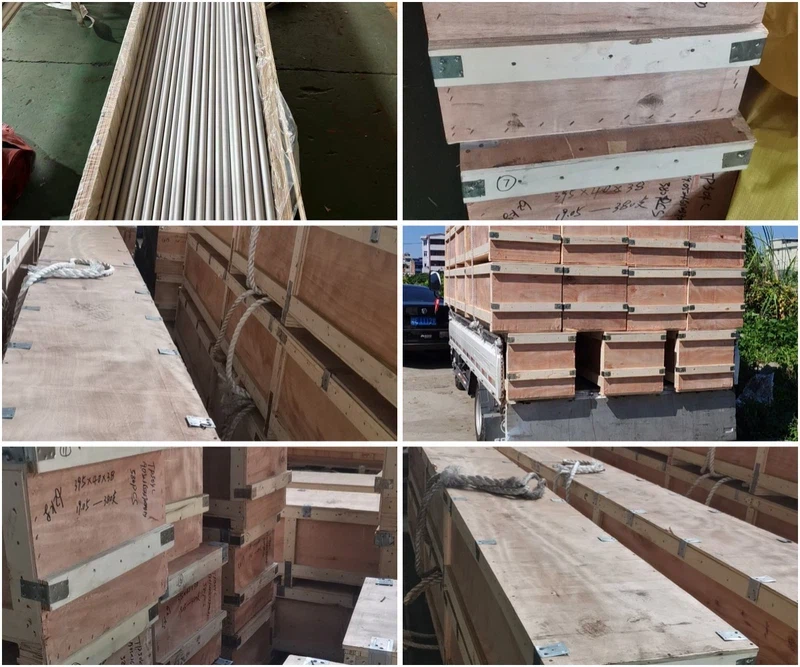
Gnee Steel specializes in the production of a wide range of stainless steel products. Gnee Steel's product packaging includes: Steel Strapping: Pipes with an outer diameter of 3 inches or less are typically strapped together with polypropylene film to prevent rust during ocean shipping, and then secured with steel strapping. Wooden Cases/Crates: Pipes are typically packaged in wooden cases or crates to protect the pipes during transportation, especially those that are longer or have larger diameters. Seaworthy Export Packaging: Suppliers typically use standard seaworthy export packaging methods, which may include a variety of materials and techniques to protect the pipes during transportation. Tarpaulin Packaging: This prevents rain, seawater, and other external factors from penetrating the export crates during transportation. Gnee Steel specializes in the production and sale of alloy materials. Gnee Steel's products are widely used in the aerospace, chemical, power, automotive, and nuclear energy sectors, and we can provide customized alloy material solutions based on customer needs. For alloy material pricing or customized alloy material solutions, please contact us for a quote: ru@gneesteelgroup.com