


Should I choose 316 stainless steel pipe or 304 stainless steel pipe?
For general indoor or light outdoor applications, if cost is the primary consideration, 304 stainless steel should be chosen; however, for harsh environments involving saltwater, chemicals, or high chlorides, 316 stainless steel should be selected due to its superior corrosion resistance caused by its molybdenum content. For most everyday uses, 304 is an economical and adequate choice, while for projects in more corrosive environments, 316 represents a better long-term investment.
Will 304 stainless steel rust in water?
304 stainless steel has extremely strong resistance to atmospheric corrosion, water corrosion, and various chemical corrosion. Furthermore, 304 stainless steel is easy to process, making it a common material for metal castings and widely used in pump and valve components, food processing equipment, bearings, heat exchangers, and pressure vessels.

Overview of 304 Stainless Steel Pipes
304 stainless steel pipe belongs to austenitic stainless steel. Its main components include 18-20% chromium, 8-11% nickel, 2% manganese, 1% silicon, with the remainder being iron and trace impurities (<0.1%). This is the most common and well-known type of stainless steel in daily life, widely used in applications requiring moderate corrosion resistance, such as household items, kitchen utensils (pots, pans, tableware), machinery and equipment, and industrial building materials (stainless steel pipes, industrial fittings).
Overview of 316 Stainless Steel Pipes
316 stainless steel pipes also belong to austenitic stainless steel. Their composition includes at least 16-18% chromium, 11-14% nickel, 2% molybdenum, 2% manganese, and 1% silicon, with the remainder being iron and trace impurities (<0.1%). Furthermore, 316 stainless steel contains approximately 2-3% molybdenum, which significantly improves its corrosion resistance in harsh environments, making it particularly suitable for applications exposed to salt water or highly corrosive chemicals.
Composition of 316 vs. 304 Stainless Steel
| Composition | Inox 304 (%) | Inox 316 (%) |
| Cr (Chromium) | 18 – 20 | 16 – 18 |
| Ni (Nickel) | 8 – 11 | 11 – 14 |
| Mo (Molybdenum) | 0 | 2 – 3 |
| C (Carbon) | 0.08 | 0.08 |
| Mn (Manganese) | 2 | 2 |
| Si (Silicon) | 1 | 1 |
| P (Phosphorus) | 0.045 | 0.045 |
| S (Sulfur) | 0.03 | 0.03 |
Physical Properties of 316 and 304 Stainless Steel
| Physical Properties | Stainless steel 304 | Stainless Steel 316 |
| Corrosion Resistance | Good in general environments; susceptible to chloride ion corrosion | Excellent in chloride environments, strong chemicals, and seawater |
| Heat Resistance | Good up to 870°C; reduces in extreme heat | Good up to 925°C, with better durability and oxidation resistance |
| Mechanical Strength | Tensile strength: 505 MPa, Elongation: 40% | Higher mechanical strength in harsh environments compared to 304 |
| Machinability and Weldability | Easy to machine, bend, and weld | Less machinable than 304 |
| Magnetic Properties | Non-magnetic in annealed state, may become magnetic after processing | Non-magnetic in annealed state, less magnetic than 304 after processing |
| Thermal Expansion | Better | Lower |
| Density (g/cm³) | 8 | 8 |
| Oxidation Resistance | Good at high temperatures but less than 316 in humid or chemical environments | Superior in humid and chemical environments |
Applications of 304 and 316 Stainless Steel
| Applications | Stainless Steel 304 | Stainless Steel 316 |
| Food Industry | Suitable for food and beverage processing due to mild corrosion resistance. Examples: brewing machines, dairy equipment | Used in food applications, especially where salt or strong chemicals are present |
| Medical Equipment | Less commonly used | Widely used in medical equipment production |
| Kitchen Equipment | Commonly used in sinks, pots, and utensils | Less common due to higher cost but used for premium-grade equipment |
| Chemical Industry | Unsuitable for strong chemicals or highly corrosive environments | Ideal for the chemical industry due to superior corrosion resistance. Examples: storage tanks, machinery in chemical facilities |
| Indoor & Outdoor Architecture | Suitable for outdoor structures but less effective in chloride-containing environments | Preferred for outdoor structures, especially in marine or chemical environments |
| Marine Industry | Unsuitable for marine applications or seawater | Ideal for marine applications and coastal structures due to seawater corrosion resistance. Examples: marine fittings like deck cleats, pulleys, bolts, nuts |
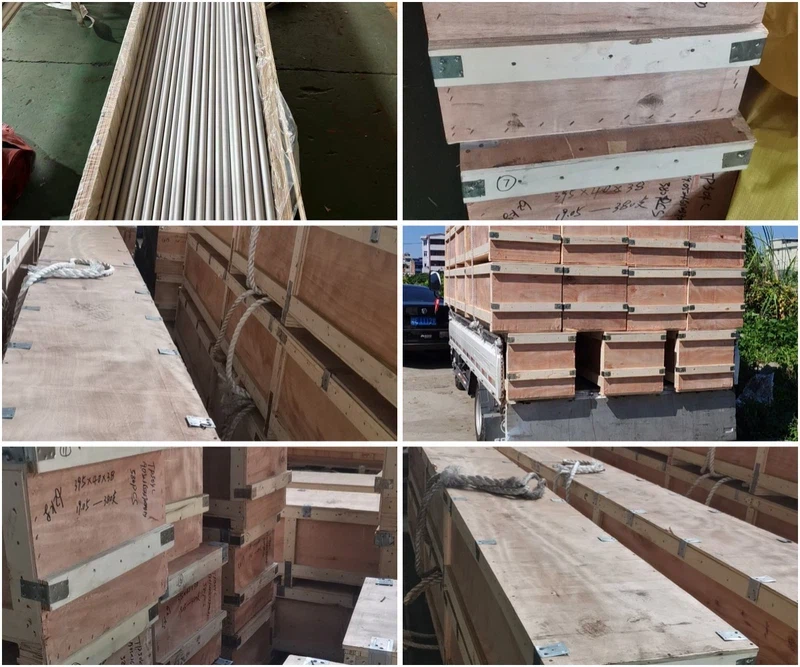
Gnee Steel specializes in the production of a wide range of stainless steel products. Gnee Steel's product packaging includes: Steel Strapping: Pipes with an outer diameter of 3 inches or less are typically strapped together with polypropylene film to prevent rust during ocean shipping, and then secured with steel strapping. Wooden Cases/Crates: Pipes are typically packaged in wooden cases or crates to protect the pipes during transportation, especially those that are longer or have larger diameters. Seaworthy Export Packaging: Suppliers typically use standard seaworthy export packaging methods, which may include a variety of materials and techniques to protect the pipes during transportation. Tarpaulin Packaging: This prevents rain, seawater, and other external factors from penetrating the export crates during transportation. Gnee Steel specializes in the production and sale of alloy materials. Gnee Steel's products are widely used in the aerospace, chemical, power, automotive, and nuclear energy sectors, and we can provide customized alloy material solutions based on customer needs. For alloy material pricing or customized alloy material solutions, please contact us for a quote: ru@gneesteelgroup.com