


For engineers in aerospace propulsion and power generation, material softening is a major pain point. Most heat-resistant steels and standard alloys experience a dramatic decline in mechanical properties once the 500°C (932°F) threshold is exceeded.
When your turbine disks, fasteners, or pressure vessels are operating at 650°C (1200°F), any compromise in strength will lead to:
Creep deformation: Components lose their tight tolerances, causing system failure.
Loss of structural integrity: Extreme thermal loads can cause spontaneous fracture if yield strength is insufficient.
Reduced service life: Frequent replacements due to material fatigue increase operating costs.
Our high-performance GH4169 alloy, designed specifically to cope with these extreme conditions, maintains an impressive yield strength of ≥1030 MPa even at 650°C.
Get an Instant Quote for Heat-Resistant GH4169
GH4169 high-temperature alloy yield strength at 650°C

GH4169 high-temperature alloy yield strength at 650°C
GH4169 superalloy (equivalent to Inconel 718) retains high strength at 650°C, with a typical tensile yield strength ranging from approximately 570 MPa to over 800 MPa, depending on the heat treatment process. Optimized heat treatment processes (homogenization + solution treatment + aging) typically yield even higher strengths (approximately 818 MPa) compared to pristine or standard-treated samples (approximately 574-582 MPa).
What is GH4169 equivalent to?
Inconel 718
GH4169 (equivalent to the American brand Inconel 718) is a precipitation-hardening nickel-based superalloy widely used in the aerospace industry due to its excellent mechanical properties (Lu et al., 2014).

1. Chemical composition of GH4169 alloy(%)
| Element | Composition (%) |
|---|---|
| Nickel (Ni) | 50.0 – 55.0 |
| Chromium (Cr) | 17.0 – 21.0 |
| Iron (Fe) | Balance |
| Molybdenum (Mo) | 2.8 – 3.3 |
| Niobium (Nb) + Tantalum (Ta) | 4.75 – 5.5 |
| Titanium (Ti) | 0.65 – 1.15 |
| Aluminum (Al) | 0.2 – 0.8 |
| Cobalt (Co) | ≤ 1.0 |
| Manganese (Mn) | ≤ 0.35 |
| Silicon (Si) | ≤ 0.35 |
| Sulfur (S) | ≤ 0.015 |
| Phosphorus (P) | ≤ 0.015 |
| Carbon (C) | ≤ 0.08 |
| Copper (Cu) | ≤ 0.3 |
| Boron (B) | 0.001 – 0.006 |
Click to download the GH4169 alloy PDF file now.
2. Physical properties of GH4169 alloy
| Property | Value |
|---|---|
| Density | 8.19 g/cm³ |
| Melting Point | 1260 – 1320 °C |
| Thermal Conductivity | 11.2 W/m·K (at 20°C) |
| Specific Heat Capacity | 435 J/kg·K (at 20°C) |
| Electrical Resistivity | 1.25 µΩ·m (at 20°C) |
| Coefficient of Thermal Expansion | 13.0 x 10⁻⁶ /°C (20 – 100°C) |
| Young's Modulus | 204 GPa |
| Poisson's Ratio | 0.29 |
3. Comparison of mechanical properties of GH4169 alloy
The secret to GH4169's industrial durability lies in its precipitation-hardening microstructure (γ′′ phase). This structure ensures that the material retains its "rigidity" and strength even when other materials become less tough and weaker.
GH4169 tensile strength and yield strength data (fully aged):
| Temperature (℃/°F) | Yield Strength σp0.2 (MPa) | Tensile Strength σb (MPa) | Elongation (%) |
| 20°C (68°F) | ≥ 1030 MPa | ≥ 1240 MPa | ≥ 12% |
| 650°C (1200°F) | ≥ 1030 MPa | ≥ 1000 MPa | ≥ 15% |
| 700°C (1292°F) | ≥ 850 MPa | ≥ 950 MPa | ≥ 18% |
Click to contact our professionals to recommend the right alloy
4. Applications of high-strength GH4169 alloy
Aerospace Propulsion: Turbine discs, engine shafts, and high-strength fasteners.
Gas Turbines: Combustion chamber liners and structural bolts.
Nuclear Power: High-strength springs and structural members exposed to radiation and heat.
Oil & Gas: Downhole tools and wellhead components requiring NACE MR0175 compliance.


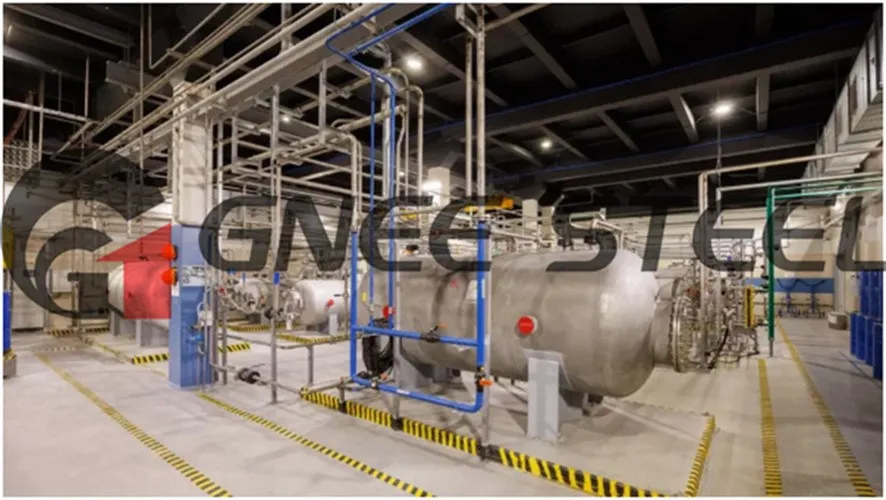

5. Why Choose Gnee Steel Tier 1 GH4169 Supplier?
In high-stakes aerospace and nuclear projects, the "lowest price" can be the most expensive mistake. We ensure Quality Assurance through:
VIM + VAR Double Melting: Eliminates internal inclusions and ensures ultra-clean microstructure for maximum fatigue life.
Precision Heat Treatment: Optimized solution and double-aging cycles to reach the precise 1030 MPa yield strength benchmark.
MTC 3.1 Traceability: Every shipment includes a complete Mill Test Certificate documenting high-temperature tensile test results.
Wholesale Pricing: We provide Direct Factory Pricing for bulk aerospace, energy, and oil & gas projects, ensuring your project is both high-quality and Cost-effective.

Contact us now to get the latest export price for GH4169 in 2026
FAQ
Q1: How does GH4169 maintain such high strength at 650°C?
A: It is due to the precipitation of the γ′′ (Gamma Double Prime) phase. This phase is exceptionally stable up to 650°C, effectively pinning the grain boundaries and preventing the material from softening under thermal load.
Q2: Is GH4169 the same as Inconel 718 in terms of strength?
A: Yes. GH4169 is the Chinese designation for the international Inconel 718 (UNS N07718). Our GH4169 is manufactured to be globally interchangeable and meets all AMS and ASTM strength requirements.
Q3: Can GH4169 be used above 700°C?
A: While it can withstand temperatures above 700°C, its yield strength begins to drop as the γ′′ phase begins to dissolve. For service above 750°C, we may recommend moving to Waspaloy or GH4145.
Q4: Do you provide high-temperature tensile test reports with each order?
A: Absolutely. Upon request, we provide specific high-temperature test data (e.g., tensile results at 650°C) to verify that the material meets your design's safety factors.