


316 and 330 Stainless Steel: Temperature Range Comparison and Applications

316 and 330 Stainless Steel: Temperature Range Comparison and Applications
316 stainless steel performs well in corrosive environments such as marine/chemical environments and can withstand moderate temperatures (up to about 1600°F before strength degradation). 330 stainless steel (high nickel) has excellent high-temperature strength and oxidation resistance, making it an ideal choice for furnace components, heat treatment, and petrochemicals, with maximum temperatures of 1900-2100°F. At extreme high temperatures where the strength of 316 rapidly declines, 330 performs significantly better than 316.
What are the differences between 303 and 316 stainless steel?
316 stainless steel has a slightly higher chromium content (16-18%) and nickel content (10-14%) than 303 and 304 stainless steel. The most significant characteristic of 316 stainless steel is the addition of 2-3% molybdenum, which significantly improves the alloy's corrosion resistance.

What is 330 Stainless Steel?
330 stainless steel is an austenitic stainless steel known for its excellent high-temperature strength and oxidation resistance. This steel is primarily alloyed with chromium (20-25%) and nickel (30-35%), with small amounts of manganese, silicon, and carbon added. The high nickel content enhances its corrosion resistance and ductility, while chromium contributes to its overall strength and oxidation resistance.
What is Type 316 Stainless Steel?
The addition of 2% to 3% molybdenum improves the corrosion resistance and pitting resistance of Type 316 stainless steel. It is more suitable for high-chloride environments, as structural pitting and crevice corrosion are more likely to occur in these environments. It exhibits excellent performance at high temperatures, with creep resistance, excellent tensile strength, and good formability and weldability. Type 316 stainless steel is widely used in high-chloride environments, such as chemical processing equipment, and in the shipbuilding industry, especially for marine fittings, valves, and pump internals. It is also widely used in the pharmaceutical and textile industries; condensers, evaporators, and storage tanks; and food processing equipment and systems. In addition, it is used in heat exchangers, laboratory workbenches, equipment, and pollution control equipment.
Chemical Composition Comparison: Stainless Steel 316 vs. Stainless Steel 330
| Element (% by weight) | Stainless Steel 316 (UNS S31600) | Stainless Steel 330 (UNS N08330) |
|---|---|---|
| Iron (Fe) | Balance | Balance |
| Chromium (Cr) | 16.0 – 18.0 | 17.0 – 20.0 |
| Nickel (Ni) | 10.0 – 14.0 | 34.0 – 37.0 |
| Molybdenum (Mo) | 2.0 – 3.0 | – |
| Manganese (Mn) | ≤ 2.00 | ≤ 2.00 |
| Silicon (Si) | ≤ 1.00 | 0.75 – 1.50 |
| Carbon (C) | ≤ 0.08 | ≤ 0.15 |
| Phosphorus (P) | ≤ 0.045 | ≤ 0.040 |
| Sulfur (S) | ≤ 0.030 | ≤ 0.030 |
| Copper (Cu) | – | – |
| Nitrogen (N) | – | – |
Temperature Range and Properties
316 Stainless Steel: Performs well below approximately 1600°F (870°C), but strength decreases significantly. Sustained high-temperature use is not recommended, especially above this temperature. Its melting point range is approximately 2500-2550°F (1371-1399°C).
330 Stainless Steel: Excellent high-temperature performance, maintaining high tensile strength below 1600°F (870°C). Can be used at 1900°F (1038°C) or higher and exhibits excellent creep resistance.
Temperature Range and Applications of 316 Stainless Steel
316 stainless steel is commonly used in highly corrosive environments, and its corrosion resistance is even superior to that of 304 stainless steel.
Its temperature range is slightly lower than that of 304 stainless steel, with a melting point of 2500°F to 2550°F. Therefore, 316 stainless steel is not as ideal as 304 stainless steel for high-temperature applications.
Application Areas
316 stainless steel is commonly used in applications involving highly corrosive substances such as chemicals and petrochemical products, automotive exhaust, and seawater, for example:
Medical devices
Pharmaceutical processing
Aerospace engines, structural components, and fasteners
Automotive exhaust and engine parts
Marine fittings, propellers, and other components
Chemical and petrochemical valves, pumps, tanks, and enclosures
Offshore oil and gas drilling platforms and pipelines
Manufacturing equipment and tools
Temperature Range and Applications of 330 Stainless Steel
Unlike 304 and 316 alloys, 330 stainless steel is often specifically marketed as a high-temperature alloy. Alloy 330 contains 18-22% chromium and 34-37% nickel, which helps it resist oxidation and scaling at temperatures up to 2000°F (approximately 1093°C). At Marin Steel, we generally recommend limiting exposure temperatures below 1900°F (approximately 1088°C) to help maintain other excellent properties.
For applications exceeding 1900°F (1088°C), using alloys specifically formulated for high-temperature environments (such as Inconel) may be a better choice.
Applications
Due to its heat resistance, 330 stainless steel is commonly used in applications requiring high-temperature exposure, such as:
Heat Treatment
Vessels, fans, and salt pans for heat treatment furnaces
Boiler fittings
Gas turbine components
Petrochemical furnace components and heat exchangers
Gnee Steel also supplies custom Inconel 600 products in various sizes and specifications. Please send us your drawings for a quote!
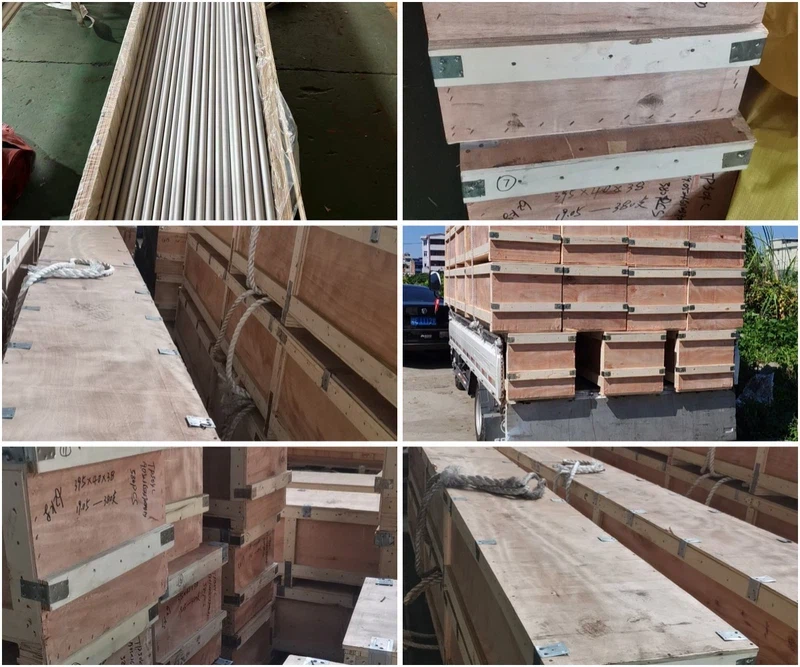
Gnee Steel specializes in the production of a wide range of stainless steel products. Gnee Steel's product packaging includes: Steel Strapping: Pipes with an outer diameter of 3 inches or less are typically strapped together with polypropylene film to prevent rust during ocean shipping, and then secured with steel strapping. Wooden Cases/Crates: Pipes are typically packaged in wooden cases or crates to protect the pipes during transportation, especially those that are longer or have larger diameters. Seaworthy Export Packaging: Suppliers typically use standard seaworthy export packaging methods, which may include a variety of materials and techniques to protect the pipes during transportation. Tarpaulin Packaging: This prevents rain, seawater, and other external factors from penetrating the export crates during transportation. Gnee Steel specializes in the production and sale of alloy materials. Gnee Steel's products are widely used in the aerospace, chemical, power, automotive, and nuclear energy sectors, and we can provide customized alloy material solutions based on customer needs. For alloy material pricing or customized alloy material solutions, please contact us for a quote: ru@gneesteelgroup.com