


304 stainless steel vs. 316 stainless steel: Which has better corrosion resistance?

304 stainless steel vs. 316 stainless steel: Which has better corrosion resistance?
316 stainless steel has better corrosion resistance than 304 stainless steel, mainly due to the addition of molybdenum, making it ideal for harsh corrosive environments such as marine environments or chemical plants; while 304 stainless steel is more economical and suitable for general indoor or mild conditions, such as typical kitchen equipment, but 304 stainless steel may perform better in certain acids (such as nitric acid).
Is 316 stainless steel corrosion-resistant?
Both 304 and 316 stainless steels contain high levels of chromium and nickel, which gives them excellent heat resistance, wear resistance, and corrosion resistance. They also have good weldability and formability, making them suitable for use in many industries.

304 Stainless Steel
Applications: General uses, kitchens, interior decoration, food processing, architectural decoration.
Corrosion Resistance: Good oxidation resistance and resistance to most common corrosives.
Main Components: 18-20% Chromium, 8-10.5% Nickel, molybdenum-free.
316 Stainless Steel
More suitable for: Marine environments, swimming pools (containing chlorine), chemical processing, pharmaceutical equipment, high-salt environments.
Corrosion Resistance: Excellent resistance to pitting and crevice corrosion caused by chlorides and acids.
Main Components: 18-20% Chromium, 8-10.5% Nickel, plus 2-3% Molybdenum.
Characteristics of 304 and 316 stainless steel
| Feature | 304 Stainless Steel | 316 Stainless Steel |
| Composition | 18% Chromium, 8% Nickel (No Molybdenum) | 18% Chromium, 10% Nickel, 2-3% Molybdenum |
| Corrosion Resistance | Excellent in mild environments; susceptible to pitting and crevice corrosion, especially with chlorides. | Superior corrosion resistance, including against chlorides and in harsh environments. |
| Strength | Good | Good, slightly higher due to molybdenum |
| High-Temperature Performance | Good for many applications, but can be susceptible to corrosion at very high temperatures. | Excellent high-temperature strength and corrosion resistance. |
| Weldability | Excellent | Excellent |
| Cost | More cost-effective | More expensive |
| Typical Applications | Food processing equipment, kitchen appliances, sinks, architectural trim, pump and valve components. | Marine environments, chemical processing, pharmaceutical manufacturing, medical devices, heat exchangers. |
| Magnetic | Slightly Magnetic | Slightly Magnetic |
Chemical composition of 304 stainless steel and 316 stainless steel
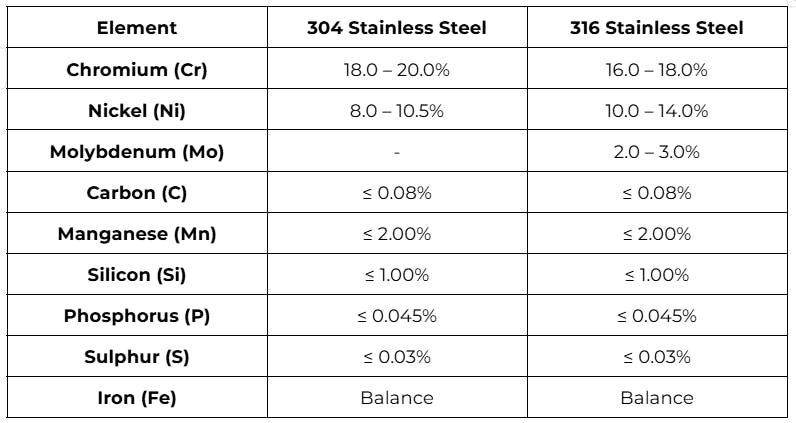
Corrosion Resistance: Detailed Analysis
The primary function of stainless steel is corrosion resistance. Below is a comparison of two stainless steels in different environments:
1. Everyday Environments (Atmosphere, Fresh Water, Mild Chemicals)
In environments with low corrosive threats-such as indoor applications, building components, kitchenware, and water treatment equipment-304 stainless steel performs excellently. It effectively resists corrosion from water, most foods, mild detergents, and the atmospheric environment. Its chromium content forms a passivating protective layer to prevent rusting.
2. Chloride and Marine Environments (Key Difference)
In these environments, 316 stainless steel performs significantly better than 304. The molybdenum in 316 significantly enhances its resistance to pitting and crevice corrosion caused by chloride ions.
Seawater and Sea Breeze: Coastal applications, marine fittings, and marine equipment benefit from the excellent salt corrosion resistance of 316.
De-icing Salt: 316 stainless steel is recommended for building panels, railings, or hardware used in snowy areas where de-icing salt is applied.
Chemical Processing: The molybdenum content in 316 stainless steel gives it better resistance to various industrial chemicals, solvents, and acidic compounds such as sulfuric acid.
Studies, including electrochemical methods, have confirmed that the passivation film of 316L stainless steel has a higher Cr/(Cr+Fe) ratio and contains molybdenum, which directly improves its resistance to pitting corrosion, making it superior to 304 stainless steel.
3. High-Temperature Performance:
Both stainless steels can be used at high temperatures, but compared to 304 stainless steel, 316 stainless steel generally maintains its strength and has better anti-scaling properties at higher temperatures (up to 1600°F for intermittent use). For applications in harsh environments such as boiler pipes or heat exchangers, the composition of 316 stainless steel (again benefiting from molybdenum) gives it an advantage.
4. Acidic Environments:
While both are resistant to many organic and inorganic acids, the molybdenum content of 316 steel makes it more suitable for handling more corrosive acids, such as those commonly found in pulp and paper processing or pharmaceutical production.
How to Choose?
For mild environments, if you prioritize cost-effectiveness, choose 304 stainless steel.
For harsh environments with high salt or chemical concentrations, choose 316 stainless steel; its higher cost translates to superior durability and a lower risk of failure.
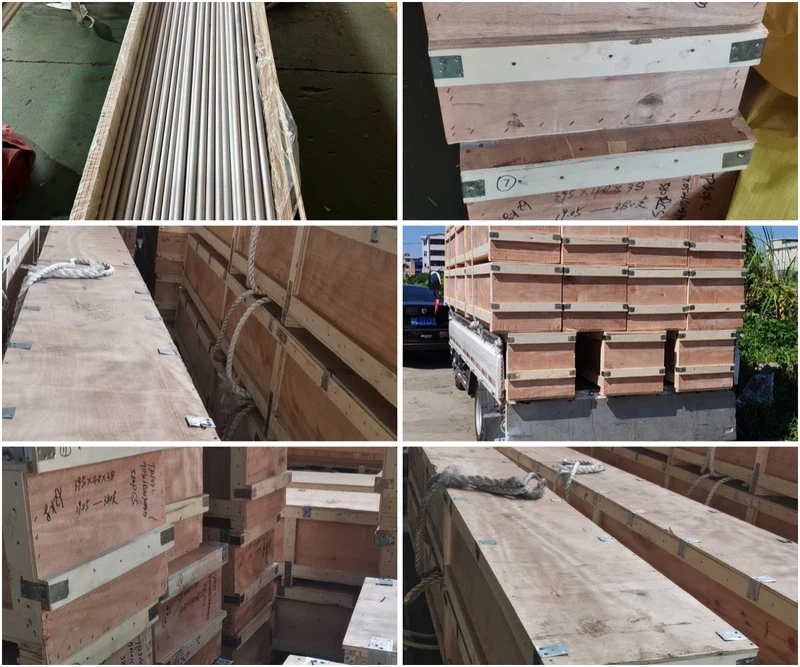
Gnee Steel specializes in the production of a wide range of stainless steel products. Gnee Steel's product packaging includes: Steel Strapping: Pipes with an outer diameter of 3 inches or less are typically strapped together with polypropylene film to prevent rust during ocean shipping, and then secured with steel strapping. Wooden Cases/Crates: Pipes are typically packaged in wooden cases or crates to protect the pipes during transportation, especially those that are longer or have larger diameters. Seaworthy Export Packaging: Suppliers typically use standard seaworthy export packaging methods, which may include a variety of materials and techniques to protect the pipes during transportation. Tarpaulin Packaging: This prevents rain, seawater, and other external factors from penetrating the export crates during transportation. Gnee Steel specializes in the production and sale of alloy materials. Gnee Steel's products are widely used in the aerospace, chemical, power, automotive, and nuclear energy sectors, and we can provide customized alloy material solutions based on customer needs. For alloy material pricing or customized alloy material solutions, please contact us for a quote: ru@gneesteelgroup.com